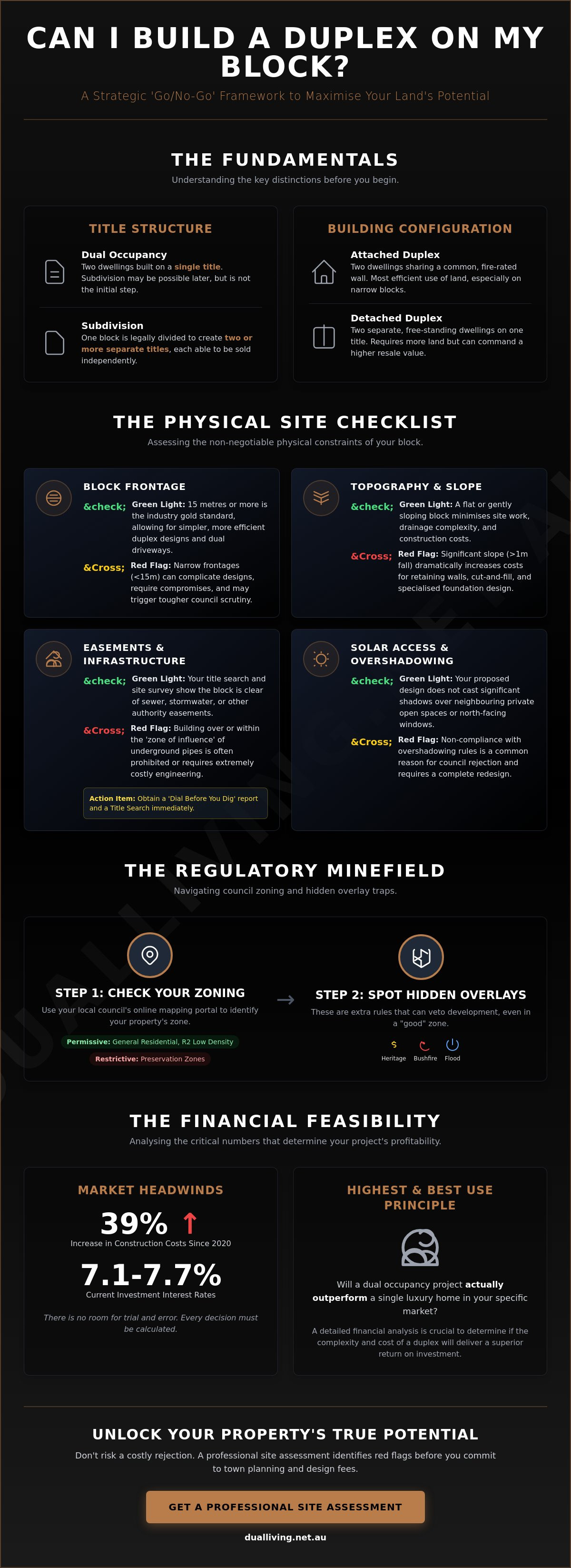
What if the only thing standing between your current equity and a high-yield windfall is a single council overlay you haven't spotted yet? Most Australian property owners look at their land and ask, "can i build a duplex on my block," only to be stalled by the fear of a costly rejection or a hidden easement that blows the budget. It's a valid concern. With construction costs having climbed 39% since 2020 and investment interest rates currently sitting between 7.177% and 7.677%, there's no room for trial and error in property development.
You need a professional strategy to move from uncertainty to a calculated investment. This guide provides the definitive "go/no-go" framework to determine if your land is a viable candidate for a duplex design or a knockdown and rebuild project. We'll break down the critical regulatory hurdles, physical site constraints, and financial benchmarks required to maximise your land value. You'll gain the confidence to pursue town planning and builder appointment with a clear, strategic understanding of your site's true potential.
Key Takeaways
- Identify the "magic numbers" for physical suitability, including why a 15-metre frontage is the industry standard for minimizing construction complexity.
- Navigate the regulatory minefield by distinguishing between Growth and Preservation zones and spotting hidden overlay traps like heritage or bushfire risks.
- Apply the "Highest and Best Use" principle to determine if a dual occupancy project will actually outperform a single luxury home in the current market.
- Follow a professional roadmap to answer "can i build a duplex on my block" through a strategic site assessment that identifies red flags before you commit to town planning.
- Understand the critical distinction between dual occupancy and subdivision to ensure your land title aligns with your long-term financial strategy.
The Fundamentals: What Defines a Duplex-Capable Block?
Most property owners assume land size is the ultimate green light for development. It isn't. You might have 800 square metres of prime dirt, but if the Local Planning Scheme doesn't align with your vision, your investment strategy is over before it begins. Understanding What Defines a Duplex-Capable Block is the first step in moving from a simple "can i build a duplex on my block" query to a viable development project. Land size is merely the baseline; the real complexity lies in the intersection of zoning, title structure, and physical orientation.
A duplex, technically referred to as a dual occupancy in most Australian jurisdictions, consists of two dwellings on a single allotment. This is fundamentally different from a standard subdivision. In a dual occupancy scenario, you are building two homes that initially exist on one title. While you may choose to subdivide later to create two separate titles, the initial town planning application must satisfy the requirements for multiple dwellings on one piece of land. This distinction is critical for your financial planning, as it impacts everything from your initial deposit requirements to your long-term exit strategy.
Attached vs. Detached Dual Occupancy
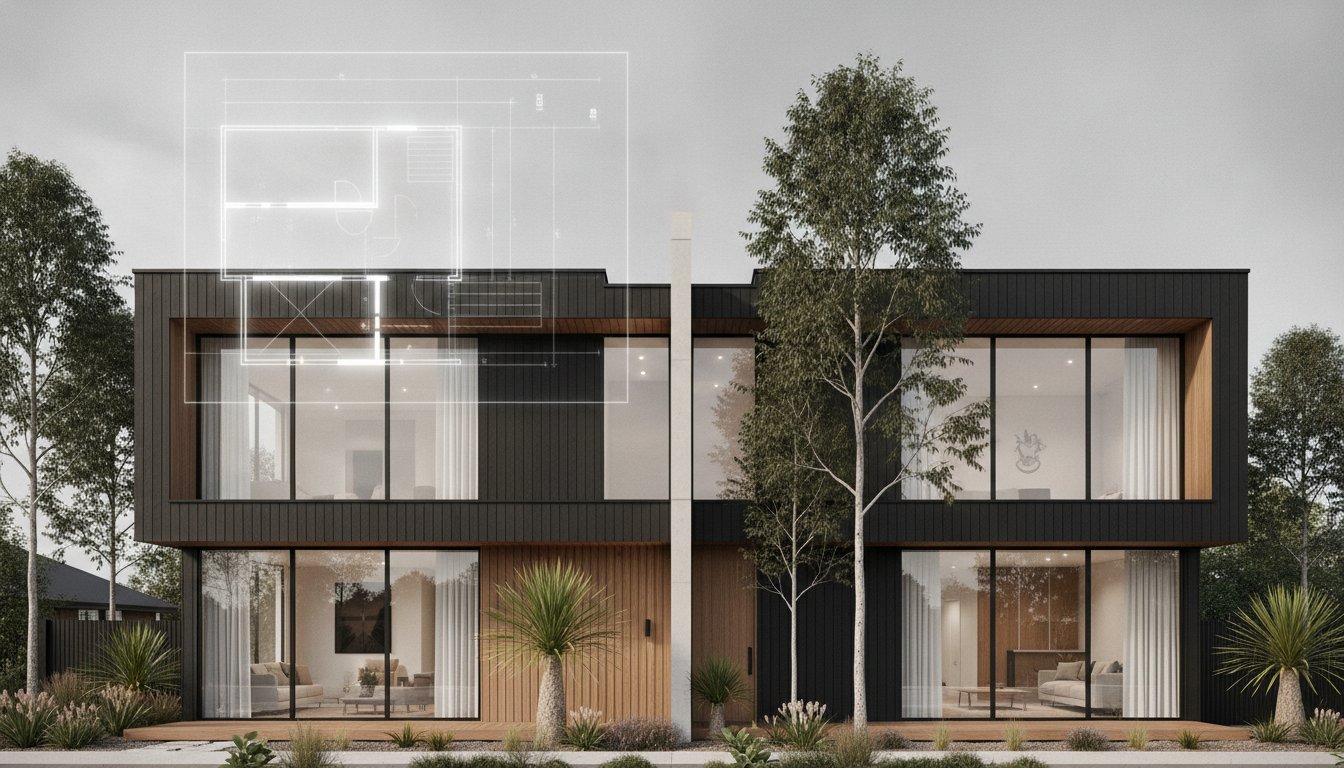
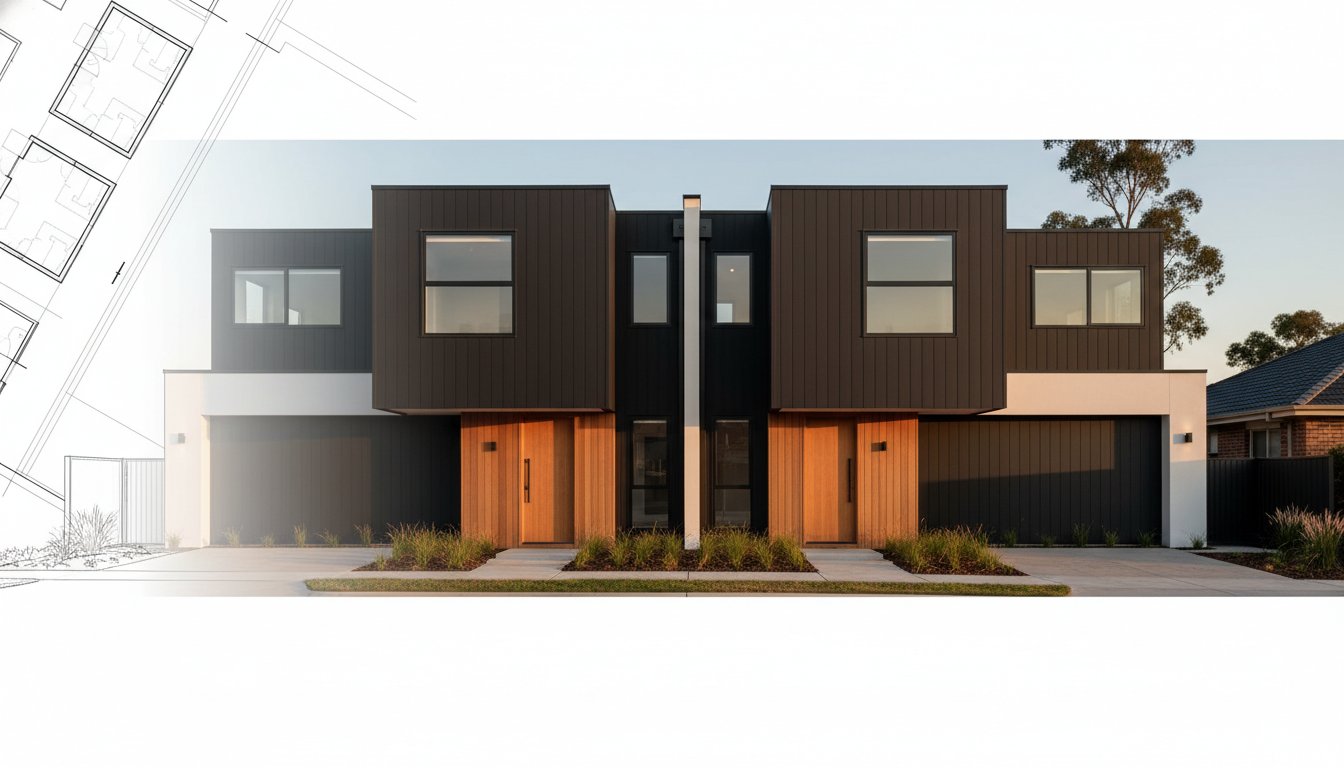
Your choice between an attached or detached configuration will dictate your site coverage and open space requirements. Attached duplexes share a common fire-rated wall, which is often the most efficient use of a narrow block. It minimises setbacks and can reduce certain infrastructure costs. Conversely, detached dwellings are entirely separate structures. While they require more land to meet council's separation and privacy rules, they often command a higher resale value due to the perceived privacy of a standalone home. Your choice here will directly affect your Duplex Designs and the eventual builder appointment process.
The National Landscape of Duplex Regulations
The regulatory environment in 2026 is shifting rapidly toward increased density. State Planning Policies are increasingly overriding restrictive local codes to address the national housing shortage. However, the local council remains the primary gatekeeper. To find your starting point, you must identify your specific zoning, such as R2 Low Density Residential or General Residential, via your local council's online mapping portal. These zones determine your "by right" development potential. Knowing your zone is the only way to answer "can i build a duplex on my block" with any degree of certainty. While state-level reforms are prioritising "missing middle" housing, your local council's specific overlays for heritage, flood, or vegetation will still dictate the final outcome of your Town Planning Applications.
Physical Site Constraints: The "Can I?" Checklist
Physical constraints are the silent killers of property development. You might have the right zoning, but if the site is steep or riddled with underground assets, the project is a non-starter. To answer the question, "can i build a duplex on my block," you must look beneath the surface. It's not just about what you can see; it's about what you can't. From hidden sewer lines to the root systems of significant trees, these factors dictate your buildable area and, ultimately, your profit margin.
Topography is your first major hurdle. A significant slope doesn't just increase construction costs; it complicates drainage and requires expensive retaining walls. While a flat block is the ideal, a sloped site isn't always a deal-breaker. However, it does require a more sophisticated approach to Duplex Designs to manage run-off and accessibility. Similarly, solar access and overshadowing rules are non-negotiable. Your design must ensure that your neighbours' private open space and north-facing windows still receive adequate sunlight. If your block is narrow and north-to-the-rear, this becomes a complex architectural puzzle.
Easements and Infrastructure
Building over a sewer or stormwater pipe is often a project killer. Before you commit, you must read your Title Search and Plan of Subdivision for any "hidden" restrictions. These documents outline easements that grant authorities the right to access pipes on your land. You must also respect the "Zone of Influence." This is the area around a pipe where the weight of a new building could cause a collapse. If your proposed Dual occupancy sits within this zone, you'll face expensive concrete encasement requirements or be forced to redesign entirely. Always start with a Dial Before You Dig (DBYD) report to map these invisible boundaries. For a professional look at your site's potential, a strategic site assessment is the most reliable way to spot these red flags early.
Frontage and Site Depth Requirements
Frontage is the width of your block at the street line. While every council differs, 15 metres is often the "magic number" for a standard attached duplex. This width allows for two ten-metre-wide homes with essential side setbacks for fire separation and maintenance access. Corner blocks are the gold mine of duplex development. They often allow for two separate street frontages, meaning each home can have its own driveway and distinct address. This configuration typically leads to an easier Town Planning Application because it reduces the visual "bulk" of the development. Mid-street blocks, however, must carefully manage vehicle crossovers. Many councils restrict the number of driveways to preserve street parking and trees. In these instances, professional insights from ML Traffic Engineers Australia can help you navigate complex access requirements and council standards. If you can't get two driveways, your design must pivot to a shared entry, which can impact the resale value of the individual units.
Global trends in urban densification, such as the Zoning and Overlays reforms seen in international markets, show a clear shift toward making these projects more accessible. However, in the Australian context, your physical site constraints remain the ultimate gatekeeper of feasibility.
Zoning and Overlays: Navigating the Regulatory Minefield
Zoning determines what you can build. Overlays determine how you build it. Even if your land is perfectly flat and 20 metres wide, the regulatory fine print can still derail your Town Planning Applications. To truly answer "can i build a duplex on my block," you must look beyond the residential label and scrutinise the specific planning scheme that governs your suburb. Not all residential land is created equal. A block in a "Growth" zone is a strategic asset; a block in a "Preservation" zone is a potential liability.
Site coverage and permeability are the two metrics that will define your building footprint. Most Australian councils cap site coverage between 50% and 60%. This means your Duplex Designs can only occupy a specific portion of the land. The rest must be dedicated to permeability, ensuring rainwater can soak into the ground rather than overwhelming local drainage. If you over-pave or over-build, your application will face immediate rejection. You must also account for Private Open Space (POS). Each dwelling typically requires a functional, secluded backyard of at least 40 to 60 square metres. If your block isn't deep enough to accommodate two sets of POS while meeting setback rules, the project isn't viable.
Common Overlays That Impact Duplexes
Overlays add a layer of complexity that can significantly inflate your budget. A Bushfire Management Overlay (BMO) requires specific BAL-rated materials, which increases construction costs. Heritage Overlays are even more restrictive. They often mandate that a new duplex must mimic the existing streetscape, limiting your ability to use modern Dual occupancy aesthetics. Flood Overlays are the most direct physical threat; they may require you to raise the entire floor level of the dwellings, adding tens of thousands to your site preparation costs. Identifying these overlays early is the difference between a profitable development and a financial drain.
Council Planning Schemes: The "Hidden" Rules
Council planning schemes contain the "hidden" rules that often catch investors off guard. Car parking is a primary example. Most councils require at least one or two off-street parking spots per dwelling. If your frontage cannot accommodate two driveways, as discussed in the physical constraints section, you may be forced to sacrifice internal living space for an integrated garage. Neighbourhood Character is another subjective but powerful hurdle. Your design must "fit in" with the local area. If the street is dominated by single-storey brick homes, a two-storey ultra-modern duplex might struggle to gain approval without significant modifications. A Pre-Application meeting with a council planner is an essential step to gauge these subjective requirements before you commit to a full Builder Appointment.
Financial Feasibility: The "Should I?" Analysis
Physical and regulatory suitability are merely the entry requirements. The real question isn't just "can i build a duplex on my block," but whether the financial outcome justifies the risk. Savvy investors apply the "Highest and Best Use" principle to decide if a dual occupancy will outperform a single luxury home. With national construction costs for a duplex averaging A$402,000 in 2026, the margin for error has narrowed. You must ensure the project yields a minimum 20% profit margin to mitigate market volatility and unforeseen site expenses.
Your analysis begins with the Gross Realisation Value (GRV). This is the total market value of both dwellings upon completion. Subtract your total project costs, including land, construction, and professional fees, from this figure. If the remaining profit doesn't hit that 20% benchmark, the project may be a liability rather than an asset. Given that construction costs have risen by 39% since 2020, achieving this margin requires a meticulous approach to budgeting and site selection.
Hidden Costs of Duplex Development
Standard building quotes rarely tell the full story. You must account for Council Open Space Contributions, which acts as a significant tax when creating a new title. Utility connection fees are another often-overlooked expense; you are bringing separate water, power, and NBN connections to two distinct homes. Perhaps the most critical "hidden" cost is time. Interest rates for investment properties currently range from 7.177% to 7.677%. Holding a property for a 12 to 18-month planning phase without a tenant can decimate your cash flow if you haven't budgeted for the cost of capital.
Maximising ROI Through Strategic Design
Profitability isn't just about cutting costs; it's about optimising yield. High-yield investors are increasingly looking at coliving models to boost rental returns on duplex allotments. Success depends on knowing your target market. In some suburbs, a high-end luxury finish is required to meet the GRV targets. In others, a functional, durable design is the more profitable choice. You can explore strategic duplex designs that are engineered to maximise land value while maintaining cost efficiency. To get a clear picture of your site's financial potential, you should secure a professional builder appointment early to lock in realistic costings.
Your Roadmap to Approval: How Dual Living Simplifies the Process
The transition from a speculative "can i build a duplex on my block" to a completed development requires more than just a permit. It demands a structured, risk-mitigated approach. While the physical and financial hurdles discussed earlier are significant, they are manageable with a clear operational roadmap. Success in 2026 relies on a sequence of technical milestones that align your site's potential with council's rigid expectations. This is how you move from a concept to a high-yield asset without the typical industry headaches.
A professional development journey follows five critical stages:
- Step 1: The Strategic Site Assessment. We identify the red flags early. This involves a deep dive into your title, easements, and local planning overlays to confirm viability.
- Step 2: Architectural Design. We balance council compliance with modern aesthetics. Your Duplex Designs must be functional for the market while satisfying strict site coverage and overshadowing rules.
- Step 3: Town Planning Management. We handle the paperwork and council negotiations. This stage is about securing your permit with minimal friction and zero design rework.
- Step 4: Builder Appointment. We tender your project to a network of high-quality, vetted builders. You get the right price and the right expertise for your specific site.
- Step 5: Project Management. We oversee the entire build. From the initial demolition to the final handover, we ensure the project stays on track and within budget.
Why a Consultant Beats a Volume Builder
Volume builders sell catalogues; we sell outcomes. Most builders will try to fit your block into one of their pre-existing templates. If your site has a slope or a unique easement, they'll often charge a premium for "customisation" or simply walk away. We provide independent advice. We find the best builder for your specific site, not ours. By centralising the management of your Dual occupancy project, you eliminate the communication gaps that lead to budget blowouts. We handle the Knockdown and Rebuild logistics, subdivision requirements, and Town Planning Applications in one cohesive workflow. It's about total risk mitigation from day one.
Get Your Site Assessed Today
Don't gamble on a 12 to 18-month project without a professional feasibility study. Understanding the "go/no-go" variables of your land is the only way to protect your capital. We act as your insider guide to the development industry, providing the clarity you need to invest with confidence. Whether you are considering a traditional duplex or modern Coliving models, the first step is always the same. You need to know what your land can legally and physically sustain before you spend a cent on construction. Organise your strategic site consultation today to see what your block is truly worth and take the first step toward maximising your property's potential.
Securing Your Financial Future Through Strategic Development
Developing a duplex in 2026 requires a shift from guesswork to precision. You now understand that physical frontage and zoning are just the beginning; the real work lies in mastering council overlays and protecting that vital 20% profit margin. Missing a single easement or miscalculating infrastructure contributions can turn a promising allotment into a financial liability. Success depends on aligning your site's physical constraints with the latest regulatory shifts.
It's time to stop asking "can i build a duplex on my block" and start executing a professional roadmap. With over 10 years of strategic development experience, we provide the insider knowledge needed to navigate complex town planning applications and secure the right builder appointment. Our expertise in high-yield coliving and duplex models ensures your project is optimised for the current Australian market. We manage the process from end to end, allowing you to focus on the results rather than the red tape.
Unlock your land’s potential with a professional site assessment and gain the clarity required for a successful build. Your path to a high-performing property asset starts with a single, calculated step. Move forward with the confidence that your investment is built on a solid strategic foundation.
Frequently Asked Questions
What is the minimum land size required to build a duplex in Australia?
Minimum land size requirements vary significantly between local councils, but most require between 450 and 600 square metres for a dual occupancy. However, land size is often secondary to frontage. If you don't have the necessary 15 to 18 metre width required by your local planning scheme, the total area becomes irrelevant for most duplex designs.
Can I build a duplex on a block with an easement?
You can build on a block with an easement, provided your dwellings don't sit directly over the restricted area. If your proposed build falls within the "Zone of Influence" of a sewer or stormwater pipe, you'll likely face additional costs for concrete encasement. This is a critical factor to verify when asking "can i build a duplex on my block" before committing to a purchase.
Do I need to subdivide my land before I build a duplex?
No, you don't need to subdivide before you begin construction. Most developers apply for a dual occupancy permit first and then pursue a plan of subdivision either during the build or after completion. Building on a single title initially can often simplify your initial town planning applications and financing structures.
How much does a town planning application for a duplex cost?
Total costs for a town planning application include council fees, land surveyor reports, and various professional consultant fees. You must also account for infrastructure contributions, which are essentially a tax paid to the council for creating an additional dwelling. These fees are separate from your architectural design and construction costs.
Can I build a duplex on a corner block more easily?
Corner blocks are highly prized because they offer two street frontages, which councils generally prefer for dual occupancy projects. This layout allows for separate driveways and distinct addresses for each home. It also reduces common issues like overshadowing and shared access, which can lead to a faster and less contentious approval process.
What is the difference between a duplex and a dual occupancy?
"Dual occupancy" is the legal planning term used by councils to describe two dwellings on a single allotment of land. A "duplex" is a specific architectural configuration where those two dwellings share a common fire-rated wall. While every duplex is a dual occupancy, a dual occupancy can also consist of two entirely detached houses on the same lot.
How long does the council approval process usually take for a duplex?
The council approval process typically takes between 6 and 12 months from the initial submission. This timeframe accounts for the internal council assessment, the mandatory public notification period, and any requests for further information. Complex sites with heritage or environmental overlays can extend this timeline significantly if not managed by a professional.
Will building a duplex always increase my property value?
Building a duplex usually increases total land value, but it is not a universal guarantee. The project's success depends on the "Highest and Best Use" principle and ensuring the Gross Realisation Value outweighs the total development costs. In some high-end suburbs, a single luxury residence may actually yield a higher profit margin than two smaller dwellings.