

Is the lowest quote on your tender a sign of efficiency or a red flag for a looming insolvency? With average construction cost inflation for 2026 estimated between 3% and 5%, picking the wrong partner doesn't just delay your project; it can destroy your capital. You're likely aware that a builder appointment is the single most critical decision in your development journey, yet the process often feels like a technical minefield designed to favour the contractor.
We understand the pressure of vetting complex claims and the fear of a builder failing mid-build. You need more than a quote; you need a strategic partner. This guide provides a professional framework to secure a fixed-price contract with a specialist who understands dual occupancy and coliving requirements. We'll show you how to move from confusion to confidence by using a vetting process that protects your ROI and ensures delivery without the usual construction headaches.
Key Takeaways
- A strategic builder appointment is the highest-risk moment in your development; learn how to manage this phase to protect your capital from insolvency risks.
- Eliminate budget blowouts by developing a technical Scope of Works that forces "apples-for-apples" quoting from every tendering party.
- Discover why builders with the most impressive showrooms often carry the highest overheads and how to avoid falling into this "sales-led" trap.
- Understand the value of independent selection to remove the inherent conflicts of interest found in builder-led design and construct models.
- Gain the framework needed to secure a fixed-price contract with a reliable builder who specialises in dual occupancy and coliving delivery.
The Strategic Importance of Builder Appointment in High-Yield Developments
A builder appointment is the formal process of selecting and contracting a construction partner once your town planning application has been approved. It is the bridge between paper-based design and physical asset delivery. While many investors treat this as a simple procurement task, it's actually the highest-risk moment in the development lifecycle. This is the point where theoretical profits meet the reality of construction costs and site management. If the transition is handled poorly, the financial viability of the entire project is at stake.
Choosing between a volume builder and a specialist makes all the difference. Volume builders thrive on repetition and flat blocks; they often struggle when faced with the complexities of dual occupancy or sloping sites. A strategic builder appointment ensures your partner's business model aligns with your project's specific yield requirements rather than forcing your design into their rigid, one-size-fits-all system.
Beyond the Quote: Aligning Builder Capability with Project Complexity
With average construction cost inflation for 2026 estimated between 3% and 5%, there's no margin for error. A standard home builder might offer an attractive price, but do they understand the nuances of duplex designs? Dual occupancy projects require specific knowledge of fire separation, acoustic ratings, and separate utility metering. Generic volume builders often lack the technical depth to manage these requirements efficiently. If your builder doesn't specialise in high-yield assets, the "lowest quote" will quickly be eroded by variations and delays. The wrong appointment effectively voids your feasibility study results before you even break ground.
Mitigating Risk Before the First Sod is Turned
Transparency during the tender phase predicts transparency on-site. When you appoint a general contractor, look for red flags in early communications. Vague answers about lead times or a refusal to provide a detailed breakdown are warning signs. A robust builder appointment process prevents future liquidated damages by locking in realistic timelines and performance benchmarks. In a market facing a structural skills shortage, you need a builder who has a reliable, proven supply chain. It's about finding a partner who values efficiency as much as you value your ROI.
The 5-Step Framework for a Successful Builder Appointment
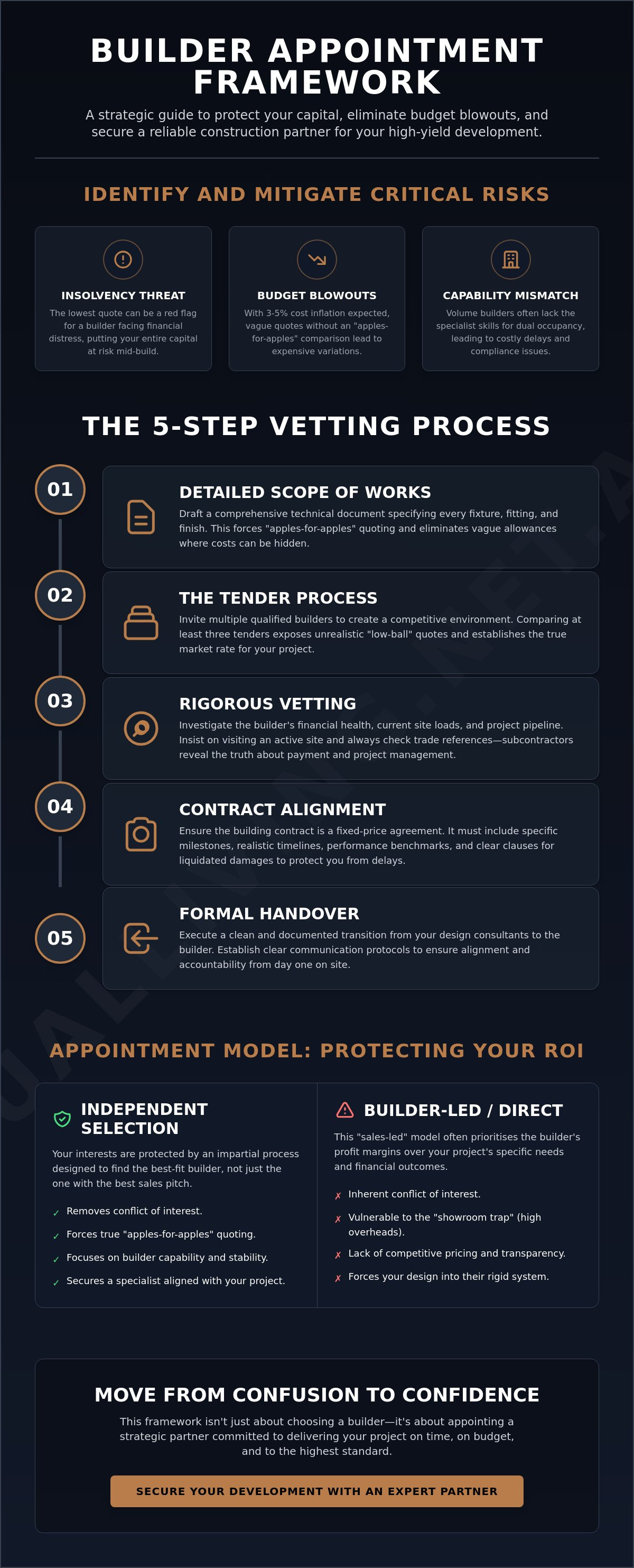
Securing a reliable construction partner requires a methodical approach. A builder appointment isn't a handshake deal; it's a technical verification of capability and commercial health. Without a structured framework, you're essentially gambling with your project's equity. To protect your ROI, follow these five essential steps:
- Step 1: Detailed Scope of Works. Draft a comprehensive document that specifies every fixture, fitting, and finish. This ensures "apples-for-apples" quoting and prevents builders from hiding costs in vague allowances.
- Step 2: The Tender Process. Invite multiple builders to submit formal proposals. This creates a competitive environment and provides necessary price discovery.
- Step 3: Rigorous Vetting. Dig into the builder's financial history, current site loads, and trade references.
- Step 4: Contract Alignment. Ensure the building contract includes specific milestones, liquidated damages, and clauses that align with your development goals.
- Step 5: Formal Handover. Execute a clean transition from your design consultants to the builder with clear communication protocols.
Running a Rigorous Tender Process
Never appoint the first builder you speak with. We recommend the "Three-Tender Rule" for every project. By comparing at least three submissions, you can identify the true market rate for your build. This process quickly exposes "low-ball" quotes. These are often intentionally underpriced to win the job, only for the builder to hit you with aggressive variations once the project is underway. A transparent tender phase is your best defence against budget blowouts.
Vetting Financial Stability and Past Performance
A builder's past success doesn't guarantee future performance if their cash flow is strained. Ask direct questions about their current pipeline and how many active sites they're managing. Physically visiting an active site is non-negotiable. It allows you to assess their quality of work and safety standards firsthand. While client testimonials are pleasant, trade references are far more valuable. Subcontractors know if a builder pays on time and manages a tight programme. Understanding the nuances of Hiring and Working with a Contractor ensures you're partnering with a business that is as stable as the structures they build. If you're still refining your strategy, reviewing your duplex designs now can help clarify the specific technical requirements you'll need to vet during the builder appointment phase.
Independent Appointment vs. Direct Booking: Protecting Your ROI
Do you want a builder who invests in your success or one who invests in their own showroom? Many developers fall into the "Sales-Led" trap. They choose builders based on glossy brochures and high-end displays. The reality is simple; those massive overheads are paid for by your margin. An independent builder appointment removes this conflict of interest. It ensures the builder is selected because they are the right fit for the project, not because they have the loudest marketing. By separating the design phase from the construction contract, you maintain control over your project's destiny.
Timing is everything. You should finalise the builder appointment to coincide with your final permit approvals. This allows for a seamless transition from the planning phase to the construction site. A development consultant acts as your strategic insider during these negotiations. We ensure you aren't just another number in a volume builder's pipeline, but a priority client with a protected bottom line.
The Hidden Costs of Sales-Led Builder Selection
Standard builder-led designs often prioritise ease of construction over maximum land value. They want a simple build; you want a high-yield asset. Watch out for Prime Cost (PC) items and Provisional Sums (PS). These are often under-quoted to make the initial price look attractive, only to bloat the budget once work begins. Having a consultant review the fine print of a standard HIA or MBA contract is essential. We identify the traps that standard agreements hide from the untrained eye, ensuring your feasibility remains intact.
How Expert Consultancy Streamlines the Handover
Professional oversight changes the relationship dynamic. The builder shifts from a mere contractor to a genuine delivery partner. This is vital for complex projects like coliving development or multi-key builds. These assets require a higher level of technical precision than a standard house. You need to know that your builder understands the specific regulatory requirements of these high-yield models before the first slab is poured. Ready to secure the right builder? Book a strategic consultation with Dual Living today.
Take Control of Your Construction Delivery
A successful development isn't just about a great design; it's about meticulous execution. By shifting your perspective and viewing the builder appointment as a strategic risk-management exercise, you safeguard your capital against market volatility and technical oversight. You've seen how a rigorous five-step framework and independent vetting can expose underpriced quotes and identify partners who truly specialise in high-yield models. Don't let a sales-led builder with high overheads erode your ROI before the first slab is even poured.
With over 25 years of industry expertise, our team provides the independent oversight needed to prioritise your financial outcomes. We specialise in the technical complexities of high-yield duplex and coliving models, ensuring your project is delivered with precision. It's time to move from the uncertainty of the tender phase to the confidence of a fixed-price contract. Maximise your development potential with expert builder appointment; contact Dual Living today. Your path to a high-performing asset starts with the right partnership.
Frequently Asked Questions
What is a builder appointment in the context of property development?
A builder appointment is the formal process of selecting and legally contracting a construction company to execute your approved plans. It's the final gatekeeper of your project's ROI. This phase involves a technical assessment of the builder's capability, financial health, and their specific experience with high-yield assets like dual occupancy or coliving. It's about moving from a theoretical design to a physical, profitable asset.
How do I choose between two builders with similar quotes?
Focus on the hidden value rather than the bottom line. Examine their current site load and talk to their active subcontractors to see if they pay on time. If two quotes appear identical, the winner is the builder who demonstrates a more reliable supply chain and a history of minimal variations on similar duplex designs. A site visit to an active project will quickly reveal their true quality standards.
What are the most common pitfalls in residential builder contracts?
The most frequent traps are unrealistic Provisional Sums (PS) and Prime Cost (PC) items that lead to post-contract budget blowouts. Many standard contracts also lack sufficient liquidated damages to cover your holding costs during construction delays. Ensure your builder appointment includes a thorough review of these clauses to keep the builder accountable for the delivery timeline and your total investment cost.
Should I appoint a builder before or after town planning approval?
You should generally wait until after you've secured town planning approval. Appointing a builder too early often leads to expensive variations if the council mandates design changes that alter the construction scope. You need a fixed design to get a truly fixed price. Waiting ensures that the tender process is based on the final, approved version of your development.
Can a development consultant help me negotiate a better build price?
Yes, a consultant adds value by stripping away the builder's marketing margins and ensuring the tender is truly competitive. We use technical knowledge to challenge unnecessary costs and verify that the proposed scope is efficient. This insider oversight often results in a more robust builder appointment that protects your feasibility study results from being eroded by "sales-led" pricing structures.
What happens if a builder goes into liquidation after appointment?
If a builder enters liquidation, you'll need to lodge a claim through your state's domestic building insurance scheme. This process is often complex and can stall your project for months while a new contractor is sourced. This is exactly why a rigorous vetting process is vital. It's your primary defence against partnering with a financially unstable entity that could jeopardise your entire development.