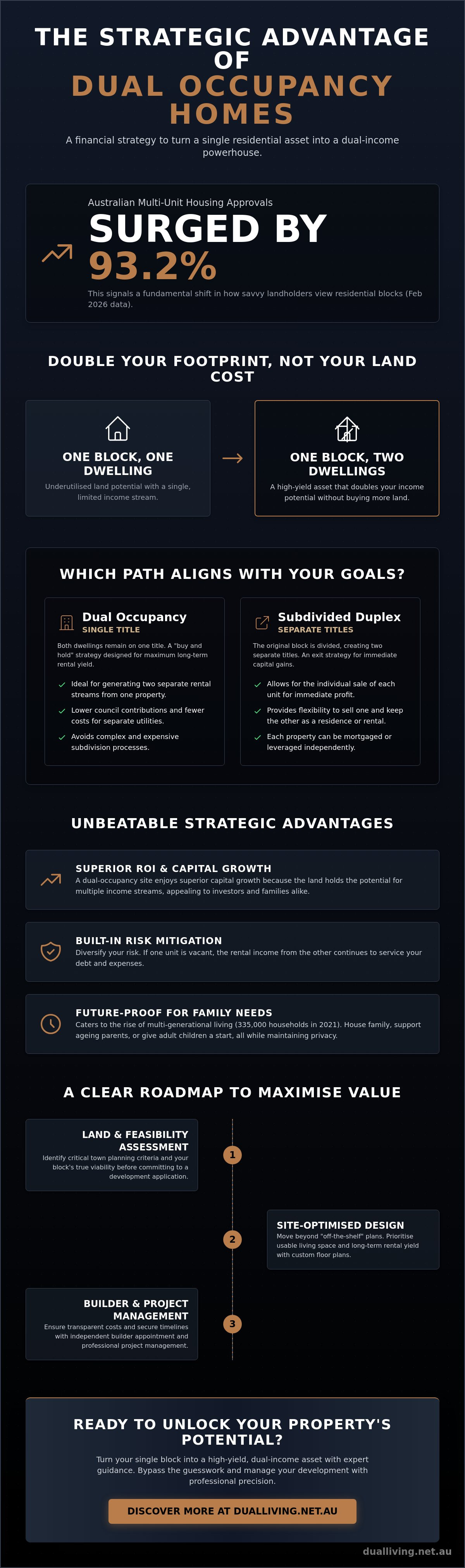
Did you know that multi-unit housing approvals in Australia surged by 93.2% in February 2026? This isn't just a statistical spike; it's a fundamental shift in how savvy landholders are viewing residential blocks. You've likely looked at your property and wondered if it could do more for your financial future. Building dual occupancy homes is the most effective way to double your footprint without doubling your land acquisition costs. It's a strategic financial play that turns a single residential asset into a dual-income powerhouse.
You're right to feel cautious about the complexity of the process. Opaque town planning hurdles and the fear of choosing an unreliable builder often stall even the best intentions. This guide shows you how to bypass the guesswork with a clear roadmap from land assessment to builder appointment. We'll preview the essential steps to maximise your rental yield or sale price while managing the development lifecycle with professional precision. Discover how to turn 2026 regulatory changes into your specific competitive advantage.
Key Takeaways
- Distinguish between single-title dwellings and subdivided duplexes to align your property with the most profitable exit strategy.
- Learn why building dual occupancy homes allows you to double density without the prohibitive cost of acquiring additional land.
- Identify the critical town planning criteria that determine your block's viability before you commit to a development application.
- Shift from "off-the-shelf" designs to site-optimised floor plans that prioritise usable living space and long-term rental yield.
- Discover the value of independent builder appointment and project management in keeping construction costs transparent and timelines secure.
Defining Dual Occupancy: More Than Just a Duplex
Land is expensive. In major Australian hubs, the cost of the dirt often outweighs the value of the structure sitting on it. This creates a fundamental inefficiency for property owners holding onto large, single-dwelling blocks. Building dual occupancy homes is the strategic solution to this problem. It allows you to maximise the utility of your land by placing two independent dwellings on a single title. It isn't just about adding a small secondary unit; it's about creating a sophisticated, high-yield asset that doubles your footprint without requiring a second land purchase.
The core advantage lies in the flexibility of the "two-home" model. You can secure two separate rental streams from one property or live in one dwelling while the second pays down your mortgage. This setup provides a financial buffer that standard residential investments simply cannot match. It's a calculated move for those who value cash flow and long-term capital stability over traditional, low-yield housing models.
Dual Occupancy vs. Duplex: Which Path to Take?
Terminology in the property sector can be notoriously vague. To understand What is a Duplex, you must first look at the title. A standard dual occupancy keeps both dwellings on one title. This typically results in lower council contributions and fewer costs associated with separate utility connections. It's a "buy and hold" strategy designed for maximum yield. In contrast, a subdivided duplex creates two separate titles. This allows for the individual sale of each unit, providing a different exit strategy for those seeking immediate capital gains.
Choosing between these paths depends on your financial goals. Are you building for immediate profit or long-term wealth? A single-title development often avoids the complex and expensive subdivision processes that can stall a project for months. It simplifies your dual occupancy homes project while still providing the same density benefits as a subdivided lot. You gain the same footprint with less administrative friction.
The Rise of Multi-Generational Living
We are seeing a significant social shift in Australia. The 2021 Census revealed that 335,000 Australian households consisted of three or more generations. This "sandwich generation" is looking for housing that offers proximity without sacrificing privacy. Dual occupancy provides exactly that. It's an integrated solution for families supporting elderly parents or adult children who are saving for their own deposits.
These floor plans are designed for evolution. What starts as a home for a teenager might eventually become a high-yield rental or a space for ageing parents. This long-term flexibility ensures the property remains relevant as your family's needs change. It's not just a building project; it's a future-proof investment in both social and financial security.
The Strategic Advantage: Why Dual Occupancy Outperforms
One block. Two incomes. No extra land costs. This is the calculated play that separates strategic investors from the rest of the market. Standard residential models often underutilise land by focusing on a single dwelling, but the 2026 market demands higher efficiency. By building dual occupancy homes, you're effectively doubling your density while bypassing the most expensive part of any development: the land acquisition. Why pay for two blocks when one can do the work of both?
The ROI analysis is clear. Two smaller, high-quality dwellings almost always outperform one large mansion in terms of rental yield. A single five-bedroom home might command a premium, but two three-bedroom homes tap into a much broader tenant pool. This diversification is your best defence against market volatility. If one unit is vacant, the other continues to service the debt. It's a risk mitigation strategy built directly into the design.
Maximising ROI Through Strategic Density
Success in property is about identifying the "highest and best use" for every square metre. Urban planners are increasingly prioritising housing density strategies to combat supply shortages in established suburbs. This creates a unique window for landholders. A dual occupancy site doesn't just offer better cash flow; it often enjoys superior capital growth because the land holds the potential for multiple income streams. You're holding a more versatile asset that appeals to both investors and multi-generational families alike.
Coliving: The High-Yield Evolution
The traditional rental model is evolving. Coliving is the new frontier of high-yield residential development, and dual occupancy homes are the perfect vehicle for this. These designs go beyond basic "shared housing" to provide sophisticated, purpose-built spaces that solve modern affordability challenges. They offer a premium living experience with private ensuites and shared communal zones, significantly increasing the per-room yield compared to a standard lease. To see how this model of high-quality shared living creates a vibrant community through local events and culture, check out Unipad and their student guide to the Lancaster region. Identifying sites suitable for coliving requires a specialist eye for proximity to transport and employment hubs. It's about matching the right design to the right demographic to ensure 100% occupancy. If you're looking to transition from a standard landlord to a high-yield developer, exploring dual occupancy options is the most logical first step. It's a lifestyle play, too. For many, it's the perfect way to downsize into a brand-new, low-maintenance home while the second dwelling funds their retirement. You stay in the neighbourhood you love, but your land starts working as hard as you do.
Town Planning and Feasibility: The Gatekeepers of Your Project
Most builders want to sell you a dream. We're here to give you the data. The no-nonsense truth is that not every block is a candidate for dual occupancy homes. Before you start picking out kitchen finishes, you must answer the one question that determines your project's life or death: "Will council let me build this?" Local development regulations are the ultimate gatekeepers, and they don't care about your ROI if your design doesn't meet their strict criteria.
Success starts with a deep dive into residential zoning. Across Australia, recent housing reforms in various states and territories have expanded opportunities for dual occupancy homes in zones like Low-Density Residential, where such developments might have previously been restricted. Other jurisdictions often feature zones such as General Residential or Neighbourhood Residential, which typically mandate minimum lot sizes, often between 300 and 400 square metres. While terminology varies globally, with some referring to similar concepts as Accessory Dwelling Units, Australian planning laws are highly specific about density, setbacks, and site coverage. A strategic feasibility study is your first line of defence against a rejected application.
Navigating the Planning Application Process
The journey from a blank site to a final planning permit is a multi-stage marathon. It begins with a comprehensive site analysis and often includes pre-lodgement meetings with council staff. This is where most unmanaged projects fail. Friction points like overlooking neighbours' properties, exceeding site coverage limits, or failing to provide enough private open space can trigger a refusal. Professional representation at council is non-negotiable. You need someone who speaks the language of planners and can defend your design against bureaucratic pushback.
The Feasibility Checklist: Avoiding Costly Mistakes
Profitability is won or lost in the feasibility phase. You must identify deal-breakers before you spend a cent on detailed designs. This includes checking for:
- Easements: Building over major sewer or stormwater lines is often prohibited or prohibitively expensive.
- Significant Trees: Many councils have strict protection orders that can force a total redesign to protect the canopy.
- Infrastructure Capacity: You'll need to verify if the existing power and water grid can support an additional dwelling without costly upgrades.
For older suburban blocks, the knockdown and rebuild lifecycle is often the most viable path. It allows you to clear the slate and design a purpose-built dual occupancy that meets modern standards and buyer expectations. Site feasibility is the foundation of project profitability.
Designing for Yield: Beyond Aesthetics to ROI
Aesthetics are secondary. In the world of property development, custom design isn't a luxury; it's a tool for site optimisation. Many builders will try to sell you "off-the-shelf" plans that look impressive in a brochure but fail to account for the unique orientation or slope of your land. Hallways don't pay rent. Living rooms do. Strategic design for dual occupancy homes focuses on minimising wasted space and maximising the usable square metres that tenants and buyers actually value.
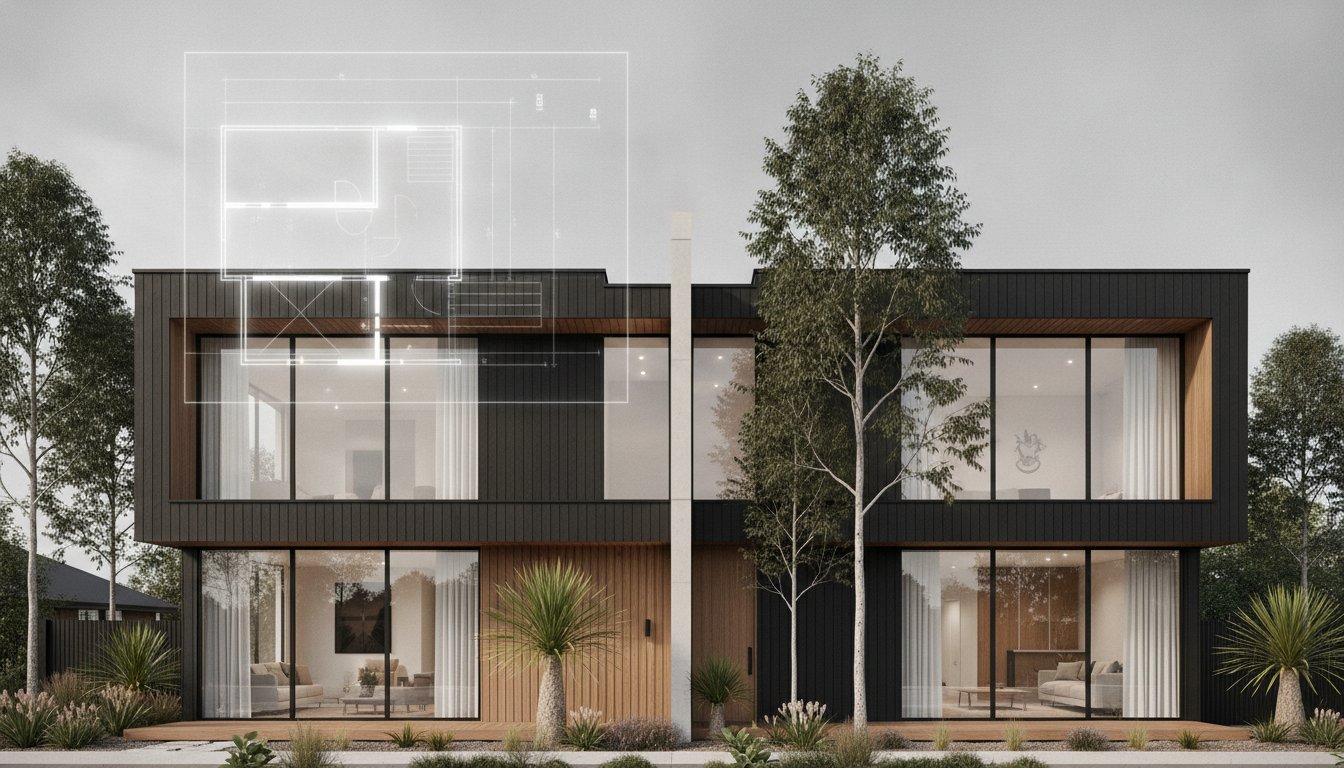
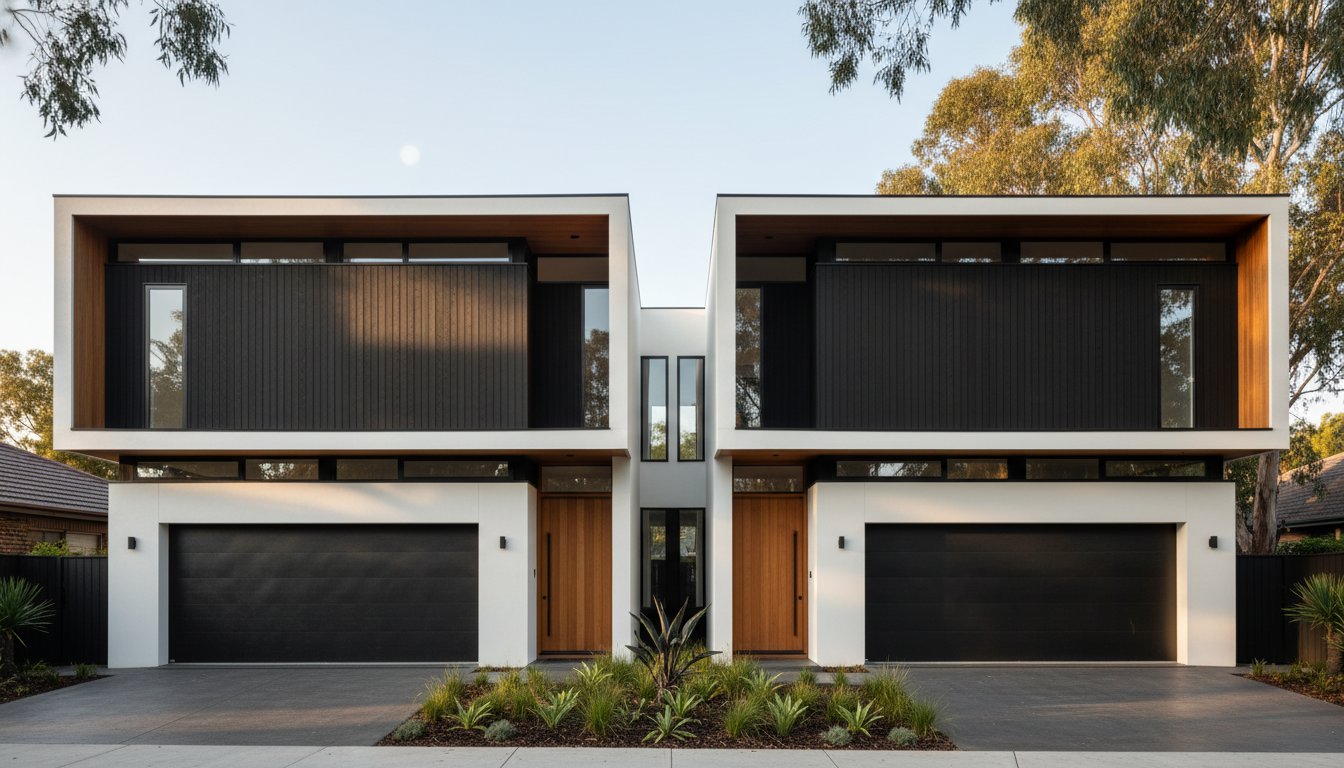
One of the most effective ways to control construction costs is through the "party wall" concept. By sharing a central structural wall, you reduce the need for expensive external cladding and improve the thermal performance of both dwellings. It's a structural efficiency that pays dividends. However, efficiency shouldn't come at the cost of street appeal. If both dwellings don't look like premium, independent homes, your resale value will suffer. You want two distinct front-door presences, not a building that looks like a subdivided block of flats.
Smart Floor Plans for Dual Living
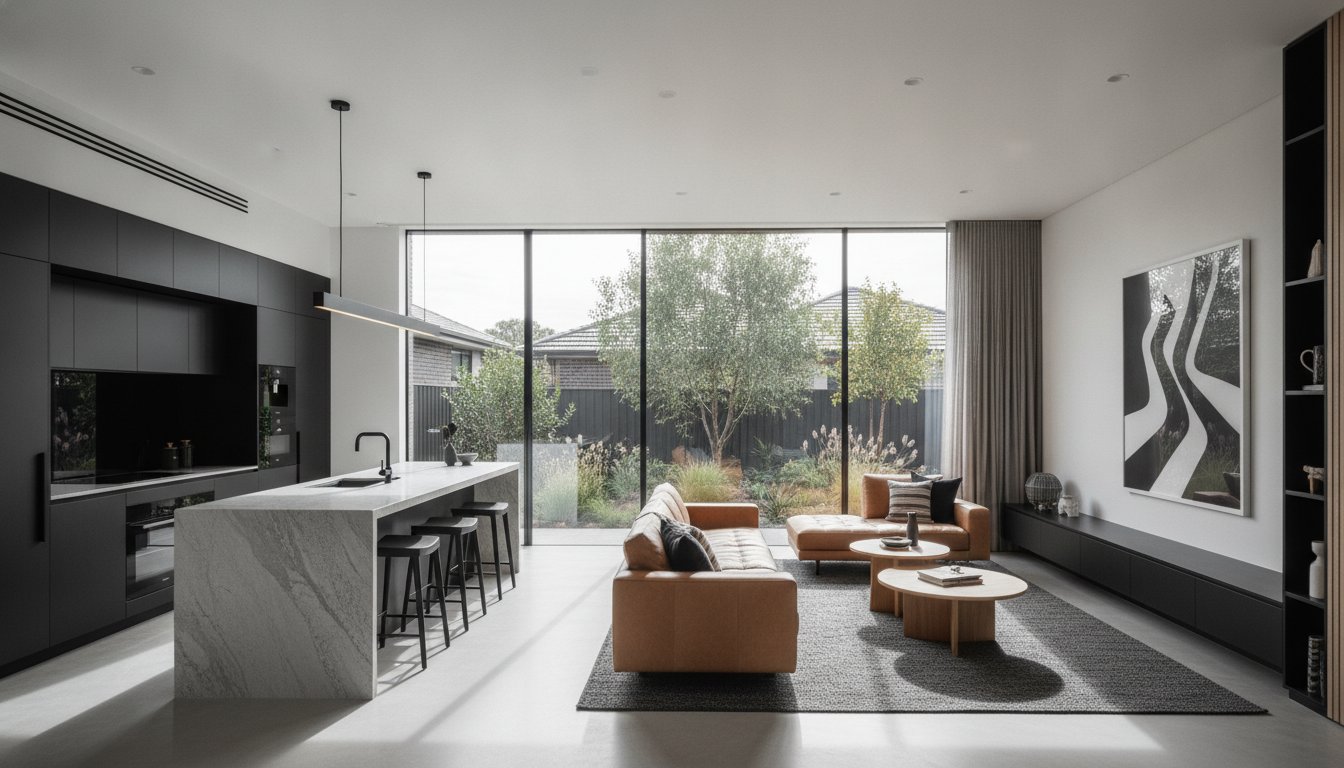
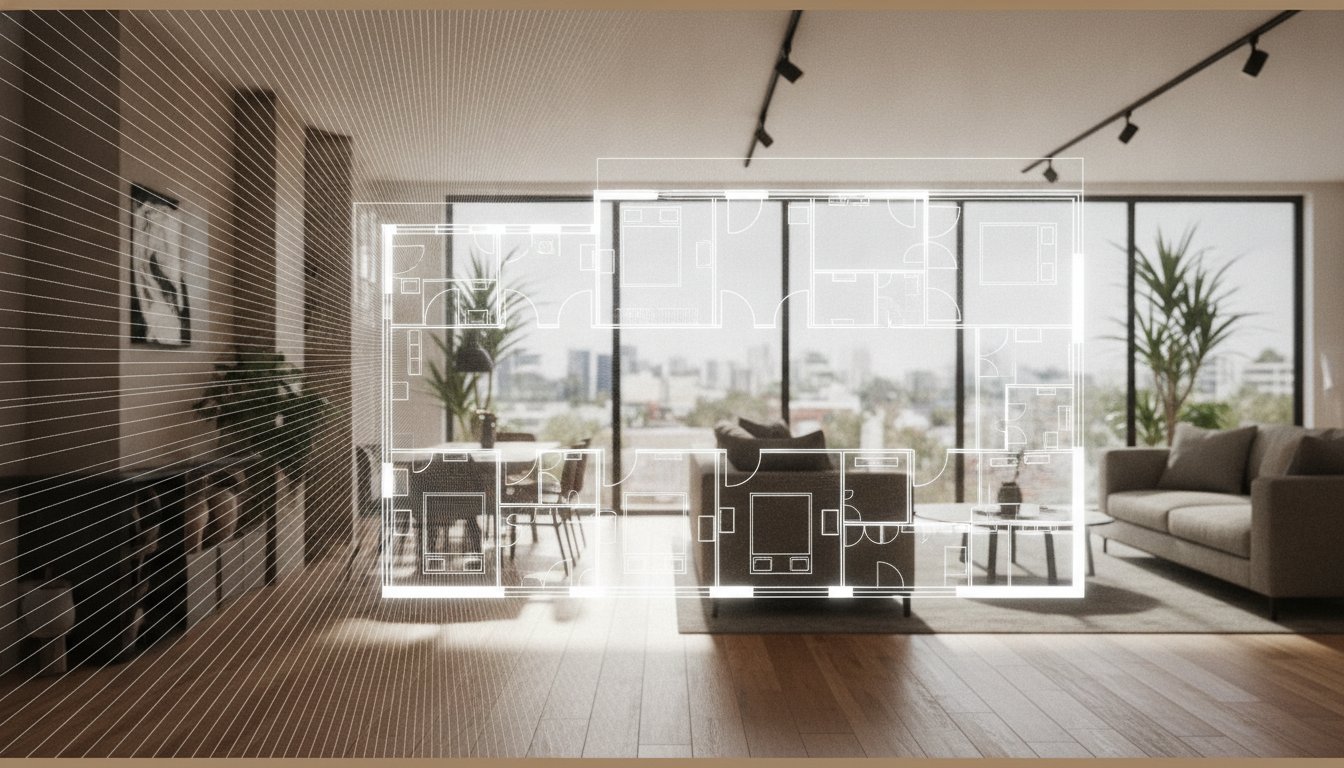
Block shape dictates your layout strategy. Wide blocks often suit "mirror image" designs that provide symmetrical street appeal. Narrower blocks require more creative, custom layouts to ensure natural light reaches the heart of both units. Privacy is the primary currency of dual occupancy homes. If tenants can see into each other's private outdoor zones, your rental yield will drop. We prioritise separate entries and acoustic buffering to ensure each resident feels they're in a completely detached environment. Explore our range of Duplex Designs to see how we optimise for specific block constraints.
For those targeting coliving yields, the floor plan must prioritise individual ensuites and soundproofing. It's about creating a "plug-and-play" investment where the design itself drives the occupancy rate. You aren't just building a house; you're building a high-performance financial asset.
Sustainable Design: Future-Proofing the Build
Energy efficiency isn't just a compliance box to tick. In 2026, high energy ratings are a major draw for tenants facing rising utility costs. A sustainable build reduces long-term holding costs and increases the property's desirability in a competitive market. We view "strategic sustainability" as a value-add. By using durable, low-maintenance materials, you protect your rental margins from being eaten away by constant repairs. Choose materials that look premium but can withstand the rigours of a long-term rental portfolio. It's about building for the next twenty years, not just the next two.
The Development Lifecycle: Why a Specialist Consultant is Essential
Building dual occupancy homes is a high-stakes financial play. It requires more than just a set of plans and a construction crew. Most property owners make the mistake of going directly to a builder, which creates an immediate conflict of interest. A builder is naturally incentivised to sell their specific service rather than maximise your site's potential, if a builder creates your plans and design with your input, then they will usually own the copyright over those plans which can limit your ability to obtain other quotes and the best price, which can be a difficult situation where some builders will then want to charge additional to sign across the copyright ownership, its a deceptive tactic that can derail a project and increase the budget dramatically after months of effort.
An independent development consultant, like Dual Living, acts as your strategic advisor. We provide the insider knowledge needed to keep every stakeholder accountable, ensuring your project remains focused on tangible outcomes rather than vague promises. We engage our preferred Architect to create custom deigns, where the property owner/client has input with their ideas and once a completed project design is completed, we can then obtain a number of quotes, eliminating the restriction of being tied to one builder only.
We manage the entire builder-client relationship. This directness removes the guesswork. You gain a partner who values efficiency and results, positioning your development for maximum market impact. From the initial knockdown and rebuild assessment to the final subdivision, every step is calculated to protect your capital and drive yield.
The Independent Builder Appointment Process
Why is the lowest quote often the most expensive choice? In the dual occupancy homes market, a "cheap" contract frequently hides realistic costs or lacks essential inclusions. We manage a professional tender process to find the right fit for your specific project. We vet builders based on their proven track record in high-density residential construction. You don't just need a builder; you need a specialist who understands the logistical challenges of dual living sites.
Our focus is on contract transparency. We advocate for fixed-price guarantees that lock in your construction costs before the first shovel hits the dirt. This level of security is essential for maintaining your project's feasibility. We look beyond the surface level to ensure the builder's capacity and quality match your investment goals.
Full Project Management: From Site Start to Keys
The development lifecycle is a sequence of critical milestones. Missing one can cause a domino effect of delays and cost overruns. We manage the five key phases of your project:
- Feasibility: Verifying the block's potential before you commit.
- Design: Creating **Dual Occupancy and **Duplex Designs that prioritise yield and liveability.
- Planning: Managing complex Town Planning Applications through council.
- Builder Appointment: Running the tender and securing the right contract.
- Construction: Overseeing the build and managing demolition or subdivision logistics.
This end-to-end management allows you to step back from the daily friction of the site. We act as the meticulous manager of execution, ensuring the final handover meets every strategic objective. Don't leave your land's value to chance. Organise a strategic site assessment with the Dual Living team today and turn your residential block into a high-performance asset.
Secure Your Financial Footprint in 2026
The Australian property market is shifting toward higher density and smarter land use. Success in dual occupancy homes isn't found in a standard catalogue of floor plans; it's won through meticulous feasibility studies and independent management of the development lifecycle. You've seen how the right design can double your income streams while strategic planning bypasses the hurdles of local council regulations. The choice between a single-dwelling footprint and a high-yield asset is ultimately a choice between standard returns and premium growth.
Transitioning from a traditional landholder to a high-yield developer requires more than just ambition. It demands specialised consultancy and end-to-end management that keeps builders accountable from demolition to final handover. Our expertise in coliving and duplex developments ensures your project is built for long-term stability and maximum tenant appeal. You've got the land; now you need the strategy to match.
Don't leave your site's potential to guesswork. Maximise your property’s potential with a strategic site assessment from our expert team. It's time to turn your residential block into a calculated competitive advantage.
Frequently Asked Questions
What is the minimum land size required for a dual occupancy home in Australia?
Minimum land size requirements vary significantly by state and local council. In Victoria, many dual occupancy developments are feasible on lots between 500 and 700 square metres, depending on the specific residential zone. You must verify your local planning scheme's frontage and site coverage rules before committing to a design. We assess all the site's requirements, early in the process and can explain what is possible for your site.
Can I build a dual occupancy on my existing block without subdividing?
You can build a dual occupancy on your existing block without pursuing a formal subdivision. This arrangement allows you to place two independent dwellings on a single legal title, which often reduces council contributions and infrastructure costs. It's a strategic move for investors who want to double their rental footprint while avoiding the lengthy administrative processes and costs associated with creating separate titles. The Subdivision process and approvals are often undertaken concurrently while the project is under construction, there are many advantages to this process that can be fully explained by our development consultants.
What is the difference between a dual occupancy and a duplex?
The primary difference lies in the title and structural configuration. A duplex typically consists of two dwellings joined by a common "party wall" or side by side and is often intended for subdivision into two separate titles. Dual occupancy homes refer to two dwellings on one title, often in a one behind the other configuration these can be attached like a duplex or entirely detached. Your site and your project goals will often determine the best strategy for you to pursue, one is an exit-strategy play for capital gains, while the other is a yield-focused investment on a single title.
How much does it typically cost to get a planning permit for a dual occupancy?
Planning permit costs depend on the estimated value of your development and your specific council's fee schedule. Dual Living can provide an outline of costs once your projects scope has been discussed, these costs form part of your feasibility, you will also need to budget for professional reports from town planners and land surveyors, which are essential for a successful application.
Is a dual occupancy development a good investment in the 2026 market?
Dual occupancy remains a high-performance investment in the 2026 market due to persistent housing supply shortages and the rise of multi-generational living. With investor variable construction loan rates starting around 5.71% p.a., the ability to secure two rental incomes from one land asset provides a significant buffer against market volatility. These dual occupancy homes tap into a growing demand for flexible, medium-density housing in established suburbs.
Do I need a separate title for each home in a dual occupancy?
You don't need separate titles to own or rent out both homes in a dual occupancy. Both dwellings remain on the original single title, which keeps your land tax and holding costs more manageable. If your goal is to sell the homes to different buyers in the future, you'll need to apply for a subdivision to create individual titles for each dwelling.
How long does the knockdown and rebuild process take for two homes?
The knockdown and rebuild lifecycle for two homes typically spans 12 to 18 months from demolition to final handover. This timeline accounts for the site clearing, the construction of two independent structures, and the necessary council inspections. Delays in the town planning phase can extend this period, which is why professional management of the development application is critical for staying on schedule.
Can I live in one home and rent out the other in a dual occupancy?
Living in one dwelling while renting out the second is one of the most effective strategies for debt reduction. This model allows you to maintain the privacy of a brand-new home while the secondary rental stream services a significant portion of your mortgage. It's a pragmatic solution for homeowners who want to stay in their current neighbourhood while their land works to fund their lifestyle or retirement.