Why settle for a single-digit yield when your backyard is hiding a six-figure equity gain? Most investors are watching their margins shrink under the 4.35% RBA cash rate, yet they overlook the most powerful lever for wealth creation. A strategic dual occupancy investment doesn't just add a second front door; it fundamentally revalues your land. You probably already realise that the 2026 property market demands more than just buying and holding in the hope of organic capital growth.
This guide provides the exact blueprint to identify, evaluate, and execute a high-yield project that doubles your rental income. We'll show you how to manufacture equity while navigating complex town planning regulations and avoiding the builder reliability issues that stall most developments. We'll also examine why upcoming tax changes, including the July 2027 negative gearing shifts, make new builds the superior choice for a de-risked portfolio. We'll move from broad strategy to the specific operational advantages of dual living, ensuring you're equipped to secure yields of up to 8%.
Key Takeaways
- Understand why site frontage and effective land use are more critical to your project's internal rate of return than raw square metreage.
- Compare strategic models to decide between the high-yield, low-rate benefits of a single title or the immediate capital injection of a duplex subdivision.
- Discover how to identify sites with genuine development potential to ensure your dual occupancy investment manufactures equity from day one.
- Avoid the "Builder Trap" by using an independent tender process to mitigate the risk of cost blowouts and unreliable delivery.
- Master the evaluation techniques required to de-risk your development and secure a reliable 6.5% to 8% rental yield in the 2026 market.
Identifying High-Yield Sites for Dual Occupancy Investment
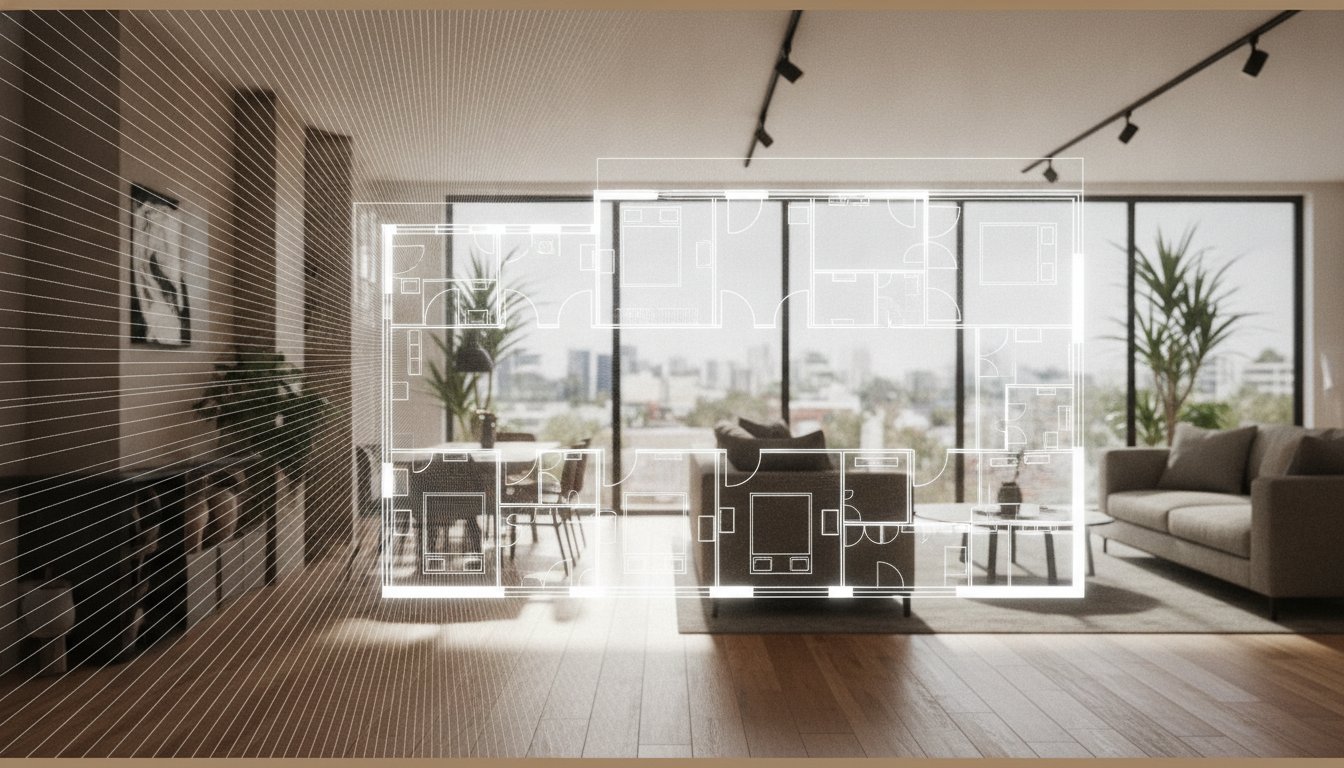
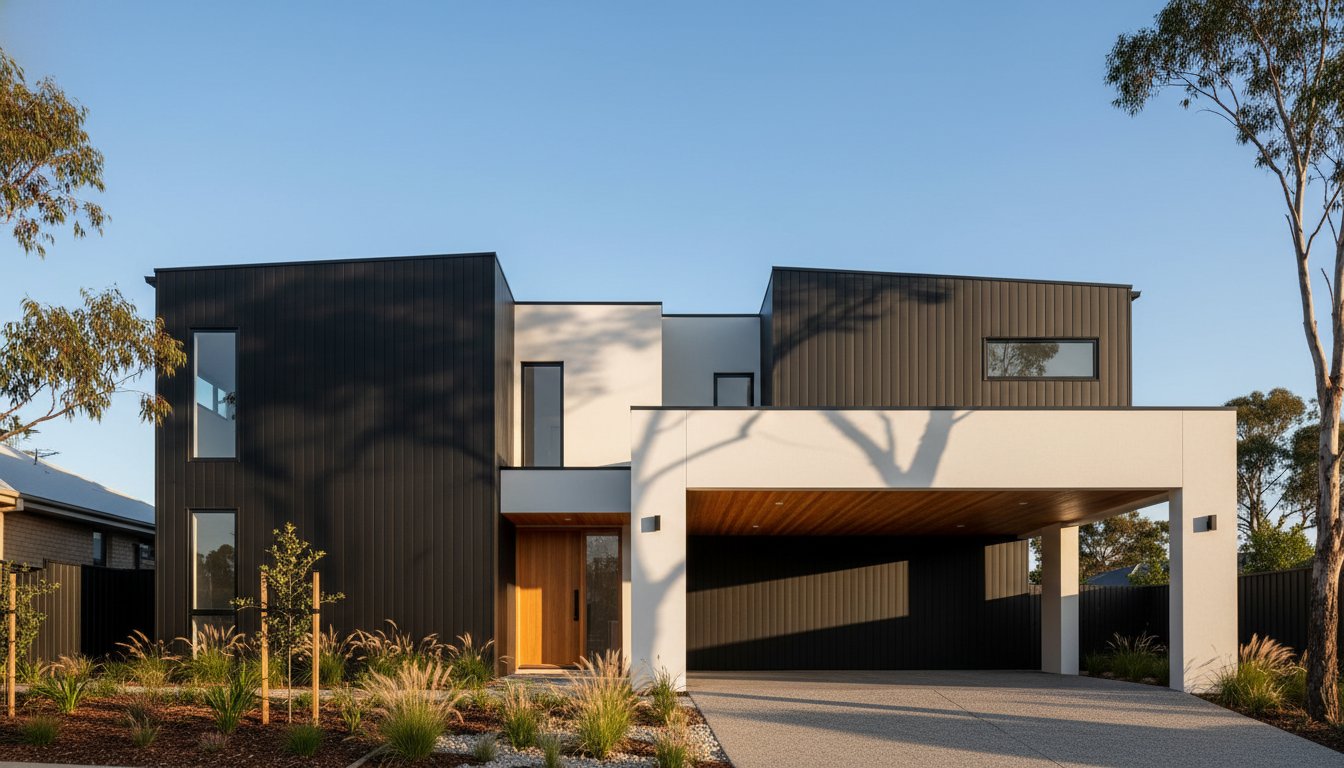
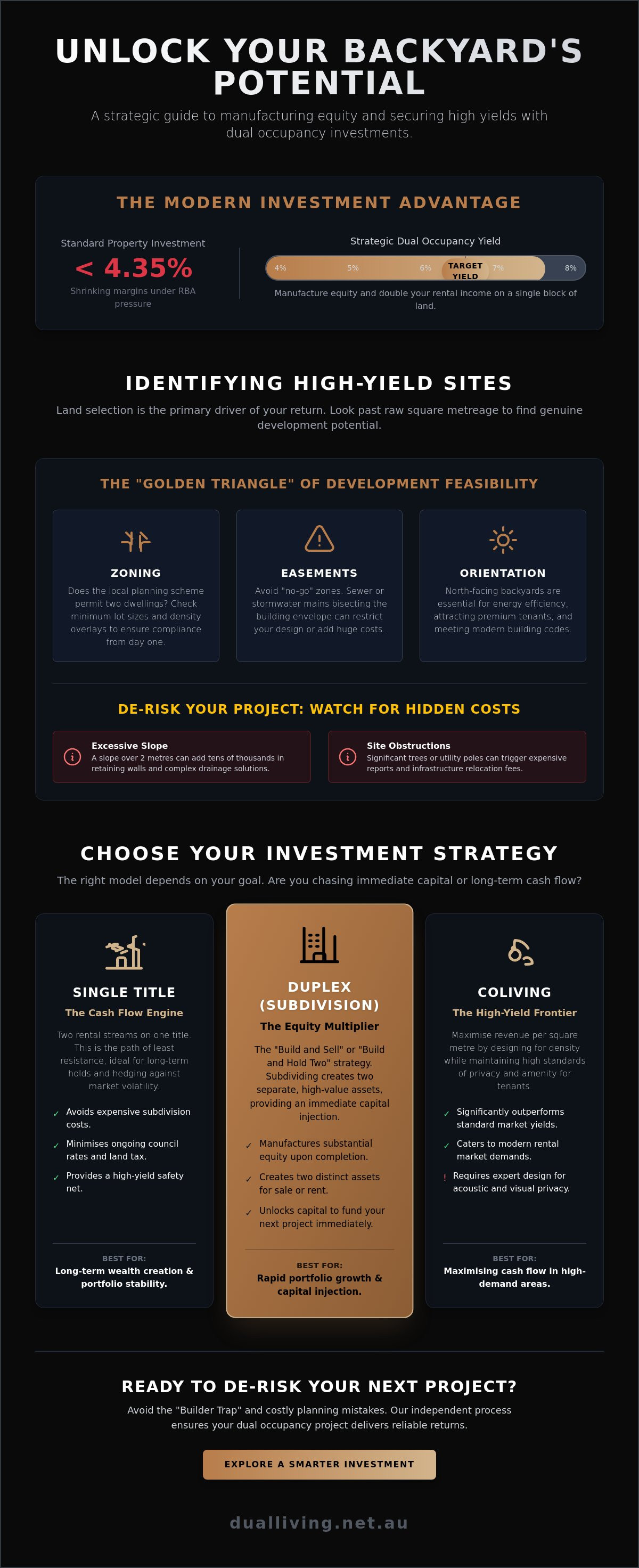
Land selection is the primary driver of your internal rate of return (IRR). Get the site wrong, and no amount of high-end finishes can rescue your margins. Savvy investors look past raw square metreage. A 600sqm block with a 20m frontage often outperforms an 800sqm battle-axe block because it allows for side-by-side configurations with independent street appeal. While a basic secondary suite might suffice for some, a sophisticated dual occupancy investment targets higher density and optimised land use to manufacture immediate equity.
Successful site identification relies on the "Golden Triangle" of development:
- Zoning: Does the local planning scheme allow for two dwellings? Check for minimum lot sizes and density overlays.
- Easements: Avoid sites where sewer or stormwater mains bisect the building envelope. These "no-go" zones can significantly restrict your floor plan or require expensive encasement works.
- Orientation: North-facing backyards aren't just a luxury; they're essential for meeting 2026 energy efficiency standards and attracting premium tenants.
Watch for hidden cost blowouts. A slope greater than two metres across the building footprint can add tens of thousands to your site costs in retaining walls and drainage. Similarly, significant native trees or existing power poles near planned crossovers can trigger expensive arborist reports or infrastructure relocation fees.
The Town Planning Filter: Can You Actually Build It?
Residential zoning dictates more than just density. It controls height limits, setbacks, and site coverage ratios. A preliminary town planning application feasibility study is non-negotiable before you sign a contract. We look at local council precedents to gauge approval probability. If your neighbours have successfully developed similar projects, your path to approval is significantly de-risked.
Infrastructure and Utility Capacity
Double the dwellings means double the demand on services. You must assess sewer and water connection points early. Are they located on your side of the road? If you need to cut across a main thoroughfare to connect utilities, your budget will take a hit. Driveway crossovers also dictate your design efficiency. Council restrictions on the number or width of crossovers can force you into a tandem driveway arrangement, which often yields a lower rental return than independent access.
Strategic Investment Models: Single Title, Duplex, or Coliving?
Identifying the right dual occupancy investment model depends entirely on your exit strategy. Are you chasing immediate capital or long-term cash flow? It isn't just about what you can build; it's about what you should build to achieve Highest and Best Use (HBU). Choosing the wrong model for your specific block can leave significant money on the table.
Single title projects offer the path of least resistance. You avoid the heavy costs of subdivision while benefiting from two rental streams. It's a pragmatic play for investors who want to stay under land tax thresholds and minimise ongoing council rates. For many, dual occupancy homes held on one title are the ultimate hedge against market volatility, providing a high-yield safety net that traditional houses can't match.
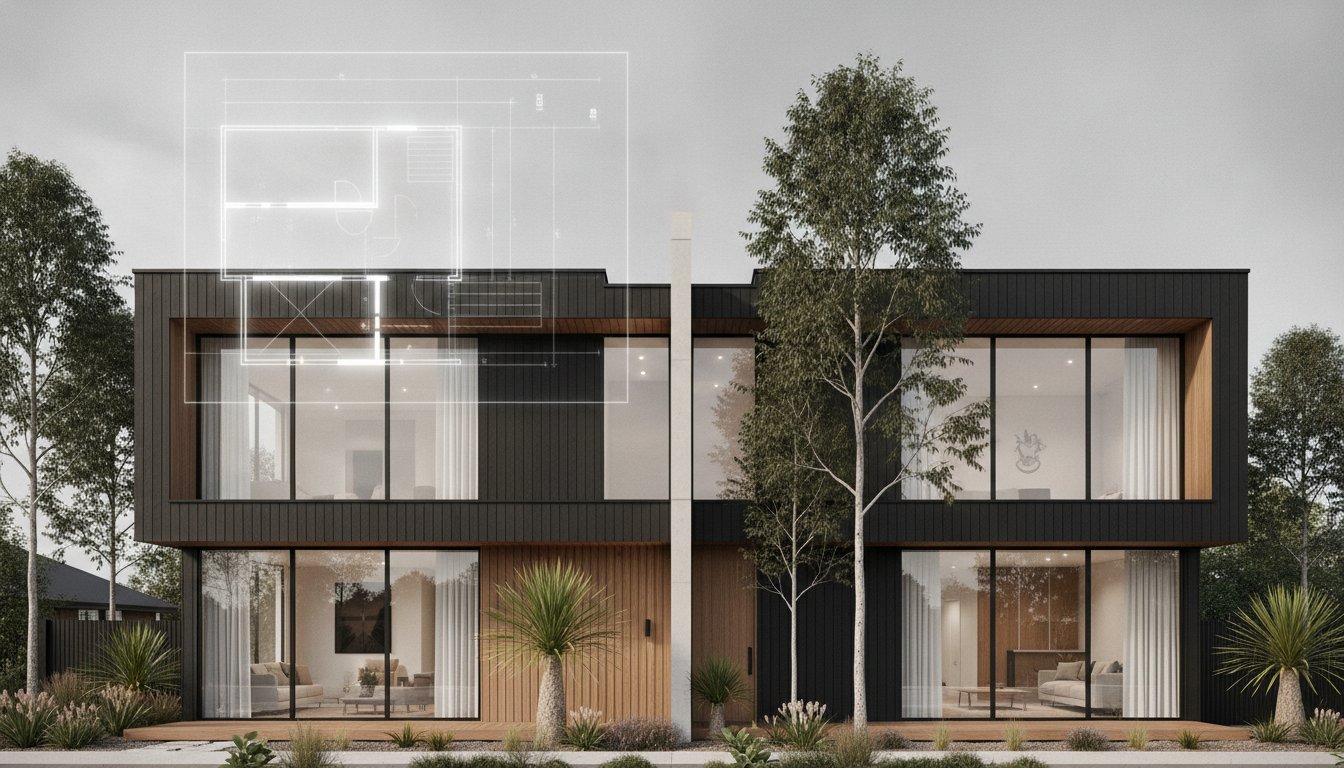
Duplex developments represent the "Build and Sell" strategy. By subdividing the land into two separate titles, you create two distinct assets. This is the fastest way to inject capital into your portfolio. It requires a larger upfront investment for town planning and separate utility metering, but the manufactured equity is often substantial enough to fund your next project immediately.
Coliving: The High-Yield Frontier
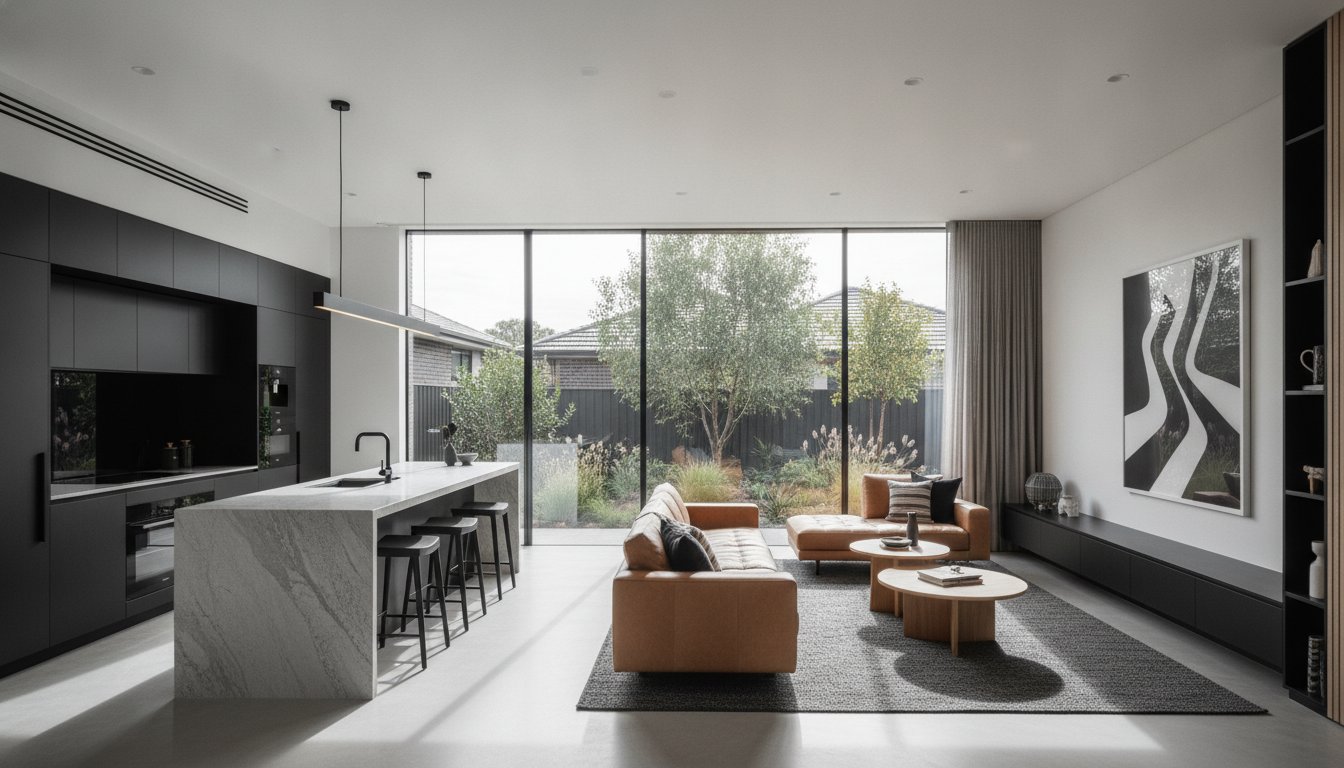
This is the current high-yield frontier. Modern investors are moving away from traditional single-family rentals because coliving house designs maximise revenue per square metre. By designing for density while maintaining strict privacy standards, you can significantly outperform standard market yields. Success here relies on managing the human element; you must design for acoustic privacy and independent living spaces to ensure long-term tenant retention.
Subdivision vs. Dual Living
Choosing between Torrens and Strata titling is a critical financial decision. Torrens title usually commands a premium price but requires more complex infrastructure separation. Triggering a subdivision at the right moment allows you to refinance and unlock manufactured equity for your next project. Review our duplex designs to see how these ownership models impact site layout and project feasibility.
Executing the Build: Risk Mitigation and Builder Appointment
Execution is where the most meticulous plans meet reality. For a dual occupancy investment, the construction phase represents the highest concentration of financial risk. Many investors fall into the "Builder Trap" by selecting the lowest tender, only to face post-contract variations that far exceed the cost of premium alternatives. A cheap quote often masks inadequate site allowances or a builder with a precarious balance sheet. In the 2026 climate, where construction costs range from $2,000 to $4,500 per square metre, an underquoted project is a liability, not a bargain.
Strategic risk mitigation starts with a professional builder appointment. This is your insurance policy against insolvency and project delays. By running an independent tender process, you gain transparency on genuine market rates and current builder capacity. We manage the entire project lifecycle from the initial demolition through to the final handover. This ensures the design brief is met without the standard friction that plagues unmanaged builds. You aren't just hiring a contractor; you are securing a delivery partner.
Navigating the Knockdown and Rebuild Process
Coordinating a knockdown and rebuild requires precise timing to protect your margins. You must manage demolition permits, utility disconnections, and site preparation before the first slab is poured. Mismanaging this sequence leads to holding costs that erode your manufactured equity. We provide clear timeline expectations, typically spanning 12 to 18 months from design to completion, ensuring every stage is coordinated to minimise downtime and interest expenses.
The Dual Living Advantage
Our end-to-end consultancy removes the friction from complex developments. We act as your savvy specialist, leveraging insider knowledge to navigate the regulatory and construction minefields. Why manage multiple contractors yourself when you can partner with a strategist who understands the financial outcomes you're chasing? We ensure your dual occupancy investment moves from a point of curiosity to a high-yielding reality through meticulous management and a results-oriented focus.
Secure Your Financial Future Through Strategic Development
Success in the 2026 property market requires more than just capital; it requires a calculated execution strategy. You've seen how the right site and model can transform a standard block into a high-yielding asset. Whether you choose the immediate equity gain of a duplex or the consistent cash flow of coliving, your results hinge on land selection and town planning precision. A strategic dual occupancy investment isn't just about building. It's about engineering a financial outcome that outpaces the broader market.
Don't let your project fall victim to the "Builder Trap" or stall due to regulatory hurdles. Since 2015, Dual Living has specialised in end-to-end residential development, providing the expertise in town planning and builder appointment risk mitigation you need to protect your margins. Our results-oriented consultancy is designed to maximise your ROI by managing the complex variables of property development on your behalf.
Ready to unlock your land's true potential? Book a Strategic Feasibility Consultation with Dual Living today. Your next high-performance asset is closer than you think.
Frequently Asked Questions
Is a dual occupancy investment better than a traditional rental property?
Yes, a dual occupancy investment typically outperforms traditional rentals by providing two income streams from a single land parcel. This configuration often delivers yields between 6.5% and 8%, compared to the 3% or 4% seen in standard residential holds. It's a more efficient use of land that provides a cash flow buffer against rising interest rates and market volatility.
What is the minimum land size required for a dual occupancy development?
Minimum land size varies between local councils, but most require between 400sqm and 800sqm for a project. Total area isn't the only metric. Frontage width is often more critical for meeting setback requirements and driveway access. A smaller block with a wider street presence frequently offers better development potential than a larger, narrower lot.
Can I build a dual occupancy on a block with an existing house?
You can often build a second dwelling behind an existing house, provided the site meets zoning and access requirements. This strategy allows you to keep your current rental income while constructing a new asset in the backyard. You must ensure there's enough space for independent driveway access and private open space for both residents to comply with council regulations.
How much does it cost to subdivide a dual occupancy property in Australia?
Subdivision costs fluctuate based on your local government area and the complexity of utility separations. You'll need to budget for council application fees, land surveyor costs, and legal fees for new title registration. Infrastructure contributions, such as Section 7.11 or 7.12 fees in NSW, can range from $20,000 to $40,000 per new lot. These costs are essential for unlocking the capital gain of separate titles.
What is the difference between a duplex and a dual occupancy?
A duplex usually refers to two dwellings that share a common wall and are typically subdivided into two separate titles. Dual occupancy is a broader planning term that includes two houses on one title, detached dwellings, or coliving arrangements. While a duplex is a type of dual occupancy, not every dual occupancy can be subdivided into a duplex arrangement.
Do I need council approval for a dual occupancy project?
Yes, council approval is mandatory for every dual occupancy development in Australia. You'll need to submit a Town Planning Application to prove the project complies with local density, height, and setback rules. Once the planning permit is issued, you must also obtain building approval or a construction certificate before any physical work begins on the site.