
A town planning application is a strategic negotiation with the council, not just a paperwork exercise. Many developers treat the process as a box-ticking chore, only to be met with months of delays or a flat rejection. If you're confusing your planning permit with a building permit, you're already at a disadvantage. It's the difference between securing the legal right to develop the land and getting the technical green light to start construction.
We know the frustration of seeing a high-potential block stalled by bureaucratic red tape and unexpected holding costs. It's a high-stakes environment where a single oversight can quickly erode your profit margins. This guide provides the clear roadmap you need to master the complexities of the Australian planning system. You'll learn how to prepare a submission that council officers actually want to approve, ensuring you maximise your development potential while avoiding the common traps that sink most projects. We'll walk you through the entire application lifecycle, from initial site analysis to the final decision.
Key Takeaways
- Understand the critical distinction between planning and building permits to avoid expensive procedural delays and legal hurdles.
- Identify site constraints like easements and overshadowing through a professional site analysis before finalising your project designs.
- Master the town planning application lifecycle, including how to efficiently manage council Requests for Further Information (RFI).
- Leverage the expertise of town planning consultants early to navigate local council policies and maximise your block's development yield.
- Prepare for the public advertising phase with a strategy that balances community feedback with your project's commercial viability.
What is a Town Planning Application and Why Do You Need One?
A town planning application is the formal legal request you submit to your local council to gain planning permission for a specific development. It's the mechanism that determines how land is used and what can be built on it. Think of it as the council's way of ensuring your project fits within the broader "Planning Scheme", which is the set of state and local rules governing development in your specific area.
For developers, this isn't just a hurdle; it's a strategic milestone. Most dual occupancy homes and multi-unit projects require this green light before any construction activity can begin. If your project doesn't align with the local scheme's requirements for density, height, or setbacks, your application will likely face significant pushback or outright refusal.
The Difference Between Planning and Building Permits
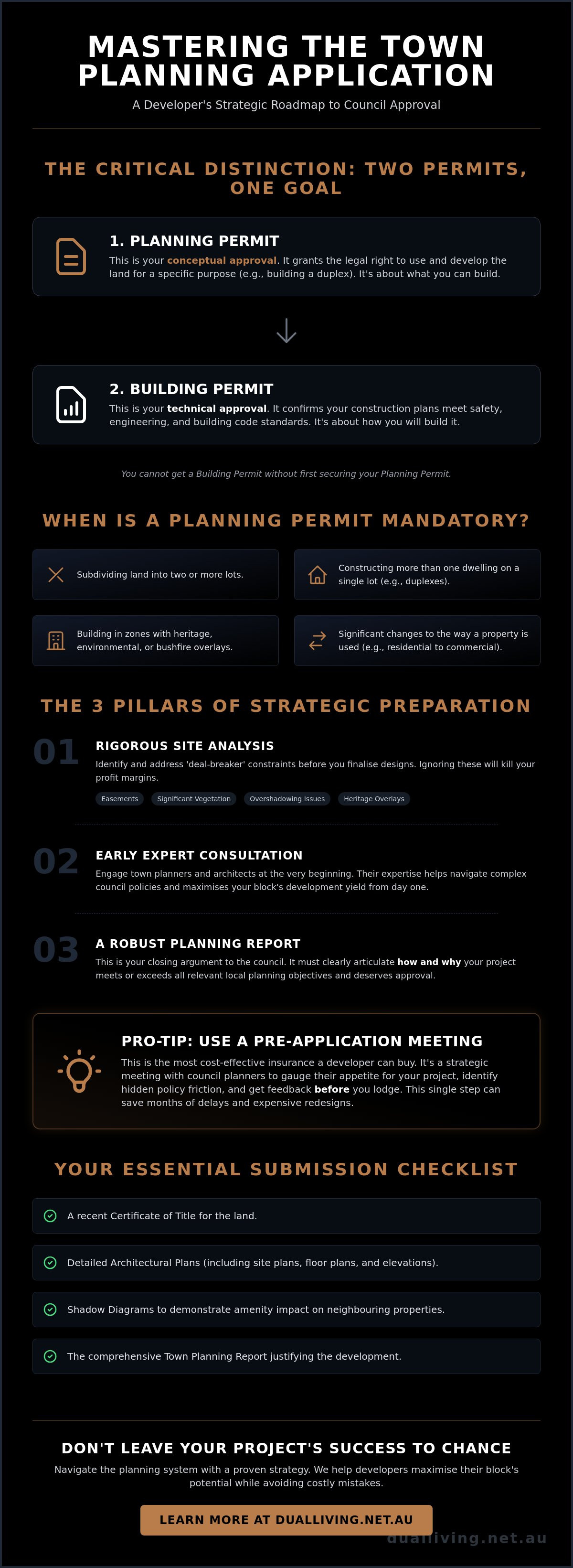
A planning permit acts as the conceptual approval for the use and design of the land, while a building permit serves as the technical approval ensuring the structure meets safety and engineering standards. Securing a town planning application approval is the critical first hurdle in the development lifecycle. You can't bypass this step; building permits are generally only issued once the planning permit is in hand.
When is a Planning Permit Mandatory?
Not every minor renovation needs a planning permit, but most serious developments do. Common triggers include:
- Subdividing land into two or more lots.
- Constructing more than one dwelling on a single lot, such as duplexes or townhouses.
- Building in zones with heritage, environmental, or bushfire overlays.
- Significant changes to the way a property is currently used.
Your land's zoning, whether it's Residential, Mixed Use, or an Activity Centre, dictates the preferred use of that site. If your proposal contradicts the zoning objectives, your path to approval becomes exponentially more difficult and expensive. Understanding these rules early is the only way to protect your profit margins.
Strategic Preparation: How to Organise a Successful Application
Success starts long before you click "submit" on a portal. Most developers fail because they treat the town planning application as a clerical task rather than a strategic negotiation. You need to identify site constraints like easements, significant vegetation, or overshadowing issues through a rigorous site analysis. Ignoring a single heritage overlay or a poorly placed sewer pipe can kill your profit margins before you've even broken ground.
Don't work in a vacuum. Engaging professional consultants like architects and town planners early allows you to pivot before you've sunk thousands into a flawed design. These experts identify the "deal-breakers" that council officers often use to stall projects. The goal is to create a design that balances your ROI targets with the council's preferred character and density requirements. It's a calculated trade-off, not a guessing game.
Your final submission must include a robust "Planning Report". This document acts as your closing argument. It shouldn't just list what you're building; it needs to articulate exactly how your project meets or exceeds local planning objectives. For a more strategic guide for developers, looking at how high-growth markets handle these complexities can provide a significant competitive edge in your local market.
The Power of Pre-Application Meetings
Why risk a flat rejection? Booking a pre-application meeting with council planners lets you gauge their appetite for your duplex design. This early feedback identifies potential friction points and policy interpretations that might not be obvious in the written guidelines. It saves you months in processing time and prevents expensive redesign fees later in the lifecycle. It's the most cost-effective insurance policy a developer can buy.
Essential Documentation for Your Submission
Your application is only as strong as your evidence. At a minimum, you'll need a recent Certificate of Title, detailed site plans, elevations, and shadow diagrams. It's also wise to consider your builder appointment strategy during the design phase to ensure your plans are actually cost-effective to construct. If you're looking to maximise the potential of your block, having a complete, professional document set is non-negotiable. Missing a single signature or an outdated title can trigger an immediate delay.
The Application Lifecycle: Lodgement to Decision
Once you lodge your town planning application, the process moves into a formal, multi-stage assessment. It rarely goes from submission to approval without a few hurdles. Usually, the first response you'll receive is a Request for Further Information (RFI). This isn't a sign of failure; it's a standard part of the council's due diligence. Responding quickly and precisely to an RFI is the best way to keep your project timeline on track.
After the RFI stage, the application moves to Public Notice, also known as advertising. For a minimum of 14 days, your proposal is open to the community. Neighbours can view the plans and lodge formal objections. Once this period closes, a council planner assesses the application against the planning scheme, considering any community feedback alongside state and local policies.
The final decision typically results in one of three outcomes:
- Permit Issued: The ideal result where you can move straight to the building permit stage.
- Notice of Decision (NOD): Council intends to grant a permit, but because there are objections, objectors have a window to appeal the decision.
- Refusal: Council has formally rejected the proposal based on specific planning grounds.
Managing Objections and Public Notice
Objections are a reality of development, but they don't have to be project-killers. A savvy developer uses proactive consultation. Talking to neighbours before the signs go up can resolve minor concerns about privacy or overshadowing before they become formal complaints. Remember, council only considers objections based on valid planning grounds. Personal gripes about property values or "not liking" the aesthetic won't carry weight if your design adheres to the local planning scheme.
What Happens if Council Says No?
A refusal isn't necessarily the end of the road. You have the right to an independent review through state tribunals like VCAT. While these appeals can be successful, they are often slow and expensive. The most profitable strategy is to avoid the tribunal altogether. Professional project management ensures your town planning application is robust, compliant, and strategically sound from day one, giving council very little room to justify a refusal.
Secure Your Development Approval with Strategic Precision
Navigating the Australian planning system requires more than just filling out forms. It's about understanding the specific nuances of your local planning scheme and anticipating council objections before they arise. By prioritising a thorough site analysis and engaging with council planners early, you transform a risky venture into a calculated investment. Success depends on your ability to present a town planning application that balances commercial yield with community character.
Don't leave your project's future to chance or bureaucratic whim. We provide expert end-to-end project management, acting as your strategic advisor to minimise planning friction and accelerate your timeline. Our team specialises in high-yield dual occupancy and coliving designs, ensuring your submission is robust enough to withstand the scrutiny of the public notice phase. We bridge the gap between complex regulations and tangible development outcomes.
Maximise your development potential—contact Dual Living for a strategic planning assessment today.
Take the next step with the confidence of a seasoned developer. Your land has untapped potential; we have the expertise to unlock it.
Frequently Asked Questions
How much does a town planning application cost in Australia?
Total costs depend on the project's scale and the specific local council's fee schedule. You will encounter two main types of expenses: statutory council fees for processing the town planning application and professional fees for consultants like town planners and architects. While council fees are fixed based on the development's estimated cost, consultant fees vary depending on the complexity of the design. Cutting corners on preparation usually leads to higher costs later through delays.
How long does the town planning approval process typically take?
Most developers should budget between six and twelve months for a standard town planning application to reach a decision. While statutory timeframes often suggest a 60-day window, Requests for Further Information (RFIs) and public advertising phases frequently extend this timeline. Projects with significant community objections or complex environmental overlays can take even longer. Efficiency depends entirely on the quality of your initial submission; a clean application moves faster.
Can I lodge a town planning application myself or do I need a consultant?
You can legally lodge an application yourself, but doing so without professional representation often leads to costly rejections. Navigating the intricate layers of a local Planning Scheme requires technical expertise that most owner-builders lack. Professional consultants identify potential policy conflicts before they become "deal-breakers" at the council level. It's a strategic choice: save a few dollars upfront or protect your project's long-term ROI with an expert-led strategy.
What is the difference between a planning permit and a building permit?
A planning permit authorises the "how" and "where" of a development, while a building permit focuses on the structural safety and technical compliance. Think of the planning permit as the council's agreement that your design fits the neighbourhood's character and zoning. In contrast, the building permit ensures the physical structure meets the National Construction Code. You generally cannot obtain a building permit until your planning permit has been successfully issued.