
A duplex planning application is not a request for permission; it's a strategic play to unlock your site's maximum financial potential. Most developers treat the process as a mere checkbox exercise, only to be blindsided by opaque council requirements and spiralling pre-planning costs. You've likely felt the frustration of waiting on a system that feels designed to stall you. We understand that the fear of community objections or a sudden Request for Further Information (RFI) can turn a profitable venture into a holding-cost nightmare.
This guide provides the technical precision needed to master the complexities of the town planning process in 2026. Whether you're navigating the Planning System Reforms Act 2025 or the latest NCC 2025 standards, we'll show you how to secure your permit with commercial foresight. You will learn how to bypass common pitfalls, minimise RFI risks, and ensure your site yield is fully optimised. We're moving past the guesswork to deliver a clear, results-oriented roadmap for your next development.
Key Takeaways
- Shift your mindset from basic residential use to an optimised dual living strategy that unlocks hidden site value.
- Learn why the lodgement of your duplex planning application is actually the midpoint of the strategic process, not the starting line.
- Overcome subjective council hurdles by prioritising custom strategic designs that respect neighbourhood character while maximising yield.
- Secure your permit with maximum efficiency by following a roadmap designed to minimise costly Requests for Further Information.
- Gain the commercial foresight needed to navigate the 2026 regulatory landscape and transform complex planning codes into a competitive advantage.
Understanding the Duplex Planning Framework in Australia
A duplex planning application is your formal request to local council to transform a single residential lot into a dual occupancy development. It isn't a mere formality. It's a high-stakes negotiation of land use that requires technical precision. Most property owners view their land through the lens of standard residential use. Strategic investors see something else. They see an opportunity for an optimised dual living land use that doubles the utility of a single title.
In the Australian context, the physical form of a semi-detached house is common, but the planning framework behind it is complex. Your application will generally follow one of two assessment pathways:
- Permitted (Code) Assessment: A faster, "tick-the-box" process where the design meets all pre-set council criteria.
- Discretionary (Impact) Assessment: A merit-based pathway where council exercises judgement on how your project affects the local area.
Why do so many applications fail? They lack professional management. This isn't just a project cost; it's a competitive advantage. Expert oversight ensures your duplex planning application addresses council's hidden agendas before they become formal objections. It turns a standard submission into a strategic proposal that council finds difficult to refuse.
The Role of Zoning and Overlays
Residential zoning determines your base-level development rights. It defines what you can build. However, "overlays" create the real hurdles. These are specific site constraints like heritage protections, bushfire risks, or flooding levels that add layers of complexity to your design. Understanding how these intersect with dual occupancy regulations is vital for site viability. If you ignore an overlay during the pre-planning phase, you're not just risking a delay. You're risking a total rejection.
Step-by-Step: The Duplex Planning Application Process
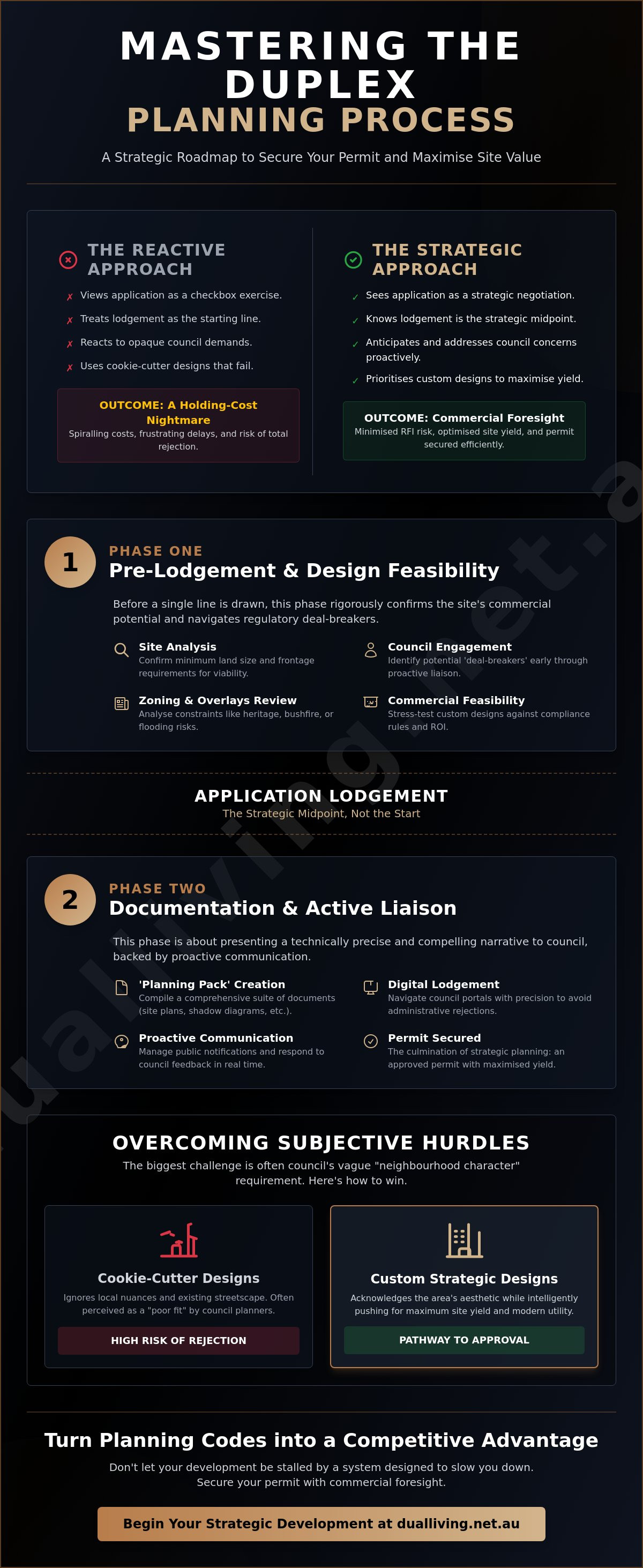
Success in property development is rarely about luck. It's about a disciplined sequence. Most landowners treat the duplex planning application as a simple submission. They draw plans, lodge them, and hope for the best. This reactive approach is why applications stall. In reality, lodgement is the midpoint of a strategic process, not the starting line. A clean, well-managed application is your best defence against the Request for Further Information (RFI), a council delay tactic that can add months to your holding costs.
Think of your town planner as a strategic advisor. They don't just fill out forms; they lead a team of technical consultants, including architects, engineers, and surveyors. Their goal is to present a narrative that council finds impossible to reject. By anticipating objections before they're raised, you maintain control of the timeline and the budget.
Phase 1: Pre-Lodgement and Design Feasibility
Before a single brick is sketched, you must confirm the site's potential. This involves a rigorous site analysis to ensure the block meets minimum land size and frontage requirements. Engaging with council planners during this window is vital. It allows you to identify potential "deal-breakers" before investing in expensive full drawings. Planning feasibility is the intersection of regulatory compliance and commercial ROI. If the numbers don't work within the rules, the project doesn't move forward. This is the stage where bespoke duplex designs are stress-tested against local constraints.
Phase 2: Documentation, Lodgement, and Liaison
Once feasibility is confirmed, you move into the "Planning Pack" phase. This is a comprehensive suite of documents including site plans, shadow diagrams, and a robust Statement of Environmental Effects. Navigating digital planning portals requires technical precision to avoid administrative rejections. After lodgement, the process enters a period of active liaison. Your advisor manages public notification periods and responds to council feedback in real time. This proactive communication keeps the application moving through the system rather than sitting at the bottom of a planner's inbox.
Strategic Factors for Securing Your Planning Permit
The most subjective hurdle in any duplex planning application is neighbourhood character. Councils often use this vague term to block developments that don't "fit" the existing streetscape. Standard, cookie-cutter designs usually fail in tight council areas because they ignore these local nuances. In contrast, custom strategic designs succeed by acknowledging the area's aesthetic while still pushing for maximum yield. It's a delicate balance between respecting the past and building for the future.
A successful permit also relies on a unified front from your technical team. If your surveyor's data doesn't align with your engineer's drainage plan, council will find the gap. Misalignment leads to RFIs and delays. This is where Dual Living's end-to-end management becomes a commercial necessity. By coordinating every consultant under one strategic vision, we remove the friction that typically stalls a duplex planning application. We ensure the documentation is consistent, professional, and ready for approval.
Design Optimisation for Planning Success
Amenity impacts are the primary focus of council assessors. They look specifically for overlooking, overshadowing, and insufficient private open space. Clever architectural choices can bypass these common objections before they are even raised. Using staggered setbacks or highlight windows can protect neighbour privacy without sacrificing your internal floor area. For a comprehensive look at managing the entire project lifecycle, refer to our town planning application pillar. It's about finding the "sweet spot" where regulatory compliance meets your commercial ROI.
Managing the 'Human Element' of Town Planning
Neighbours will often object to dual occupancy projects. It's a predictable part of the process. The key is to handle these objections with pragmatism and evidence-based design rather than emotion. Show council that your design meets the code and that neighbour concerns are addressed through technical solutions. You also need to know when to negotiate with council officers. Sometimes a minor design tweak can secure a faster "Yes" and get you on-site months earlier. Knowing which battles to fight is the hallmark of a savvy developer.
Maximising Your Site Yield in 2026
Securing a permit in the current regulatory environment requires a shift from reactive planning to proactive land value optimisation. You've seen how the framework works and why the pre-lodgement phase is critical for project viability. A successful duplex planning application isn't just a paperwork exercise. It's the result of technical precision and a unified consultant front that addresses council concerns before they become roadblocks.
The difference between a stalled project and a successful build often comes down to professional coordination across the entire development lifecycle. Our no-nonsense consultancy is designed for developers who value efficiency and tangible outcomes over vague promises. We focus on removing application friction so you can focus on the build. Secure your duplex development future with a strategic consultation and transform your property's potential into a high-performing asset. The path to approval is complex, but with the right strategic partner, it's entirely within reach.
Frequently Asked Questions
How long does a duplex planning application take to be approved in Australia?
Approval timelines typically range from four to twelve months depending on your local council and the complexity of the site constraints. While fast-track pathways like Victoria's VicSmart program exist for minor variations, a standard merit-based assessment involves mandatory public notification periods that naturally extend the clock. Delays are most common when applications are incomplete or fail to address specific overlays identified in the pre-planning phase.
What is the difference between a planning permit and a building permit?
A planning permit authorises the specific use and design of the land; whereas a building permit focuses on the structural safety and compliance of the construction. You must secure your duplex planning application approval first to ensure the design meets local zoning and neighbourhood character requirements. Once the planning permit is issued, a building surveyor or certifier can then assess the technical drawings to grant a building permit, allowing works to commence on-site.
Can I lodge a duplex planning application myself without a consultant?
You can legally lodge an application yourself, but the risk of a rejection or a protracted RFI (Request for Further Information) process is high. Council planners expect a professional standard of documentation, including detailed site analyses and Statement of Environmental Effects. Most self-managed submissions fail because they lack the technical precision required to navigate complex overlays or respond to subjective objections from the community effectively.
What happens if my duplex planning application is refused by council?
If your duplex planning application is refused, you generally have the right to appeal the decision through a state tribunal, such as VCAT in Victoria or the Land and Environment Court in NSW. Your other option is to modify the design to address the specific grounds for refusal and re-lodge the application. A strategic review of the refusal notice is essential to determine if an appeal is commercially viable or if a redesign is the faster path to securing a permit.