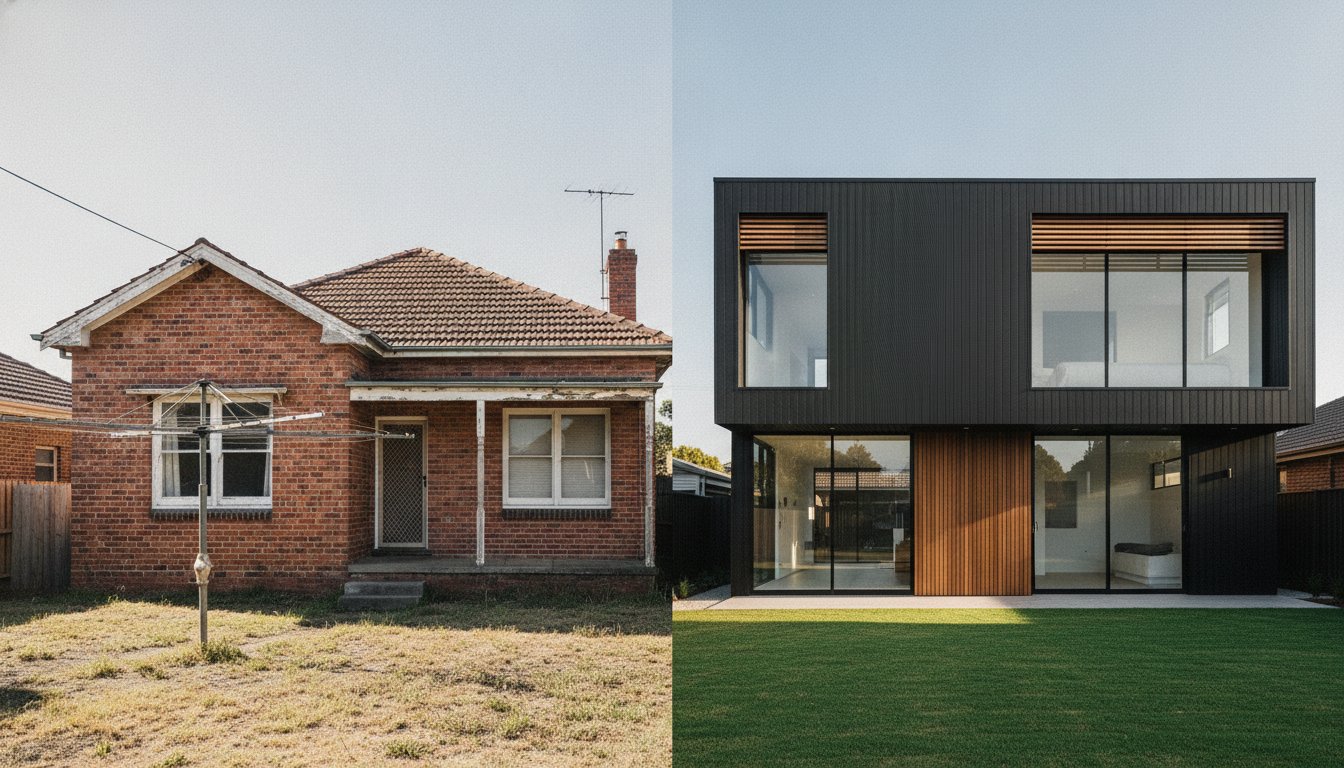
Is your family home a strategic asset or a structural liability disguised as "character"? Many Australian landowners face the same high-stakes dilemma: do you patch up an aging property or start again from the ground up? The decision between a knockdown rebuild vs renovate isn't just about floor plans; it's a calculated financial move that dictates your equity for the next decade. You likely fear over-capitalising on a project that uncovers hidden asbestos or structural rot, yet the thought of navigating complex council planning rules feels equally daunting.
We've designed this guide to replace that anxiety with a clear, data-driven roadmap. You'll discover which path offers the superior return on investment based on the latest 2026 market shifts and National Construction Code (NCC) updates. We'll break down the true cost of major renovations compared to the fixed-price certainty of a fresh build. From understanding Complying Development Certificates (CDC) to evaluating the profit potential of a duplex, you'll gain the insider knowledge needed to optimise your block's value and secure your financial future.
Key Takeaways
- Assess the structural integrity of your property to determine if the "bones" are salvageable or if they represent a liability to your future equity.
- Calculate the true ROI of a knockdown rebuild vs renovate by factoring in hidden risks like asbestos and outdated wiring that often derail major renovations.
- Evaluate the long-term lifestyle and financial benefits of modern thermal efficiency and custom orientation that older structures simply cannot replicate.
- Leverage stamp duty savings and equity growth by transforming your existing land rather than losing capital to transaction costs in a competitive market.
- Streamline your development process with an independent consultancy approach that avoids the expensive inefficiencies of the standard build model.
Deciding Between a Knockdown Rebuild and a Major Renovation
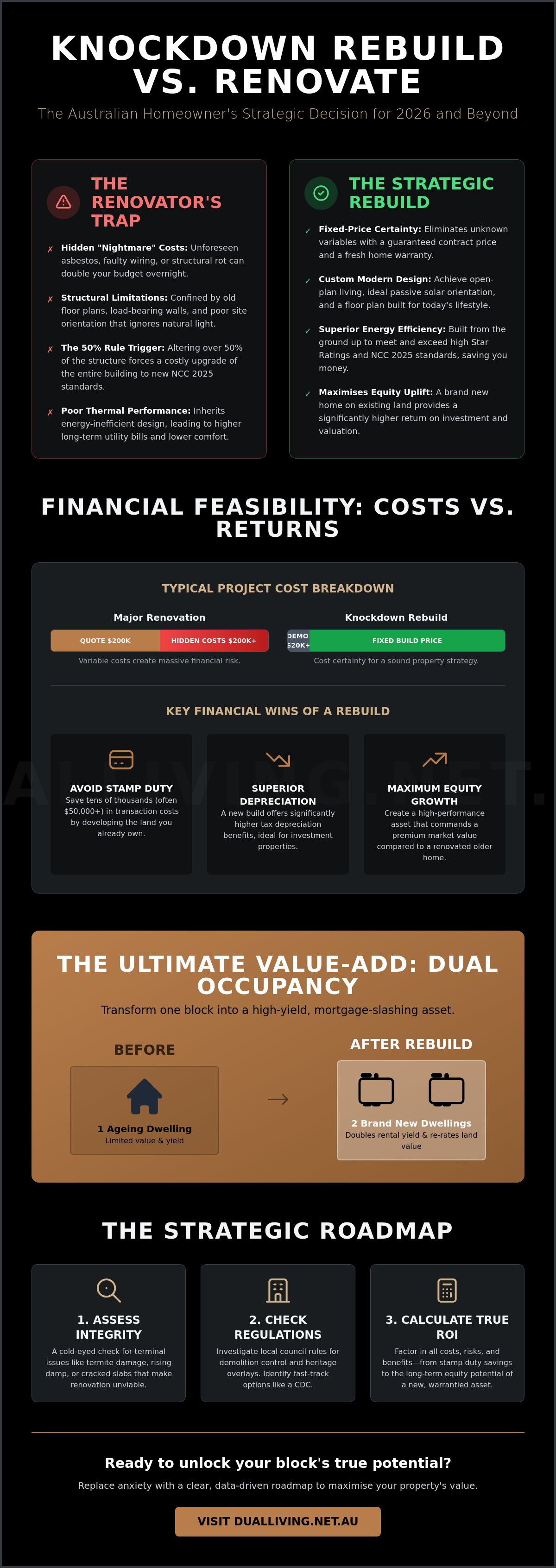
Is your property a foundation for growth or a money pit in waiting? The choice between a knockdown rebuild vs renovate requires a cold-eyed assessment of the existing structure. If the stumps are sinking or the slab is cracked, you aren't just paying for a new kitchen; you're subsidising a failing asset. Many owners fall into the "Renovator's Trap" where a cosmetic renovation hides terminal electrical or plumbing issues. You might spend six figures on aesthetics only to find the internal wiring is a fire hazard. Are you building for a kitchen island or a $500k equity uplift?
Site orientation is another critical factor. Older Australian homes often ignore the sun, resulting in dark, freezing interiors. A custom new build allows for passive solar design, which is essential under the NCC 2025 standards. A renovation rarely fixes a south-facing living room without prohibitive costs. Consider these indicators that a total rebuild is the smarter strategic play:
- Structural Integrity: Termite damage or rising damp often costs more to fix than to replace.
- Thermal Performance: Achieving a high Star Rating is significantly cheaper in a new build.
- Floor Plan Logic: Modern living demands open spaces that load-bearing walls in old homes often prohibit.
Council Regulations and Heritage Overlays
Before you pick up a sledgehammer, check for "demolition control" or heritage significance. Local councils often have strict rules on what can be removed. However, modern planning rules frequently favour a clean slate. A new build can often bypass the awkward compromises required when trying to extend a non-compliant cottage, especially if you utilise a Complying Development Certificate (CDC) for a faster approval path.
The 50% Rule: When Renovating Becomes Rebuilding
In many Australian jurisdictions, if you alter more than 50% of the structure, the entire building must be brought up to current NCC 2025 standards. This includes insulation, glazing, and accessibility requirements. Suddenly, your "budget" project costs more per square metre than a high-end new build. You lose the cost-certainty of a fixed-price contract while paying premium rates for complex structural adjustments.
Financial Feasibility: ROI, Costs, and Hidden Risks
Crunching the numbers on a knockdown rebuild vs renovate project requires looking beyond the initial quote. Older Australian homes are often landmines of asbestos, lead paint, and "dodgy" historical wiring. These hidden structural defects can turn a $200,000 renovation into a $400,000 nightmare overnight. By choosing to rebuild, you trade these unpredictable variables for a fixed-price contract and a fresh warranty period. This financial certainty is a cornerstone of a sound property strategy.
Strategic landowners also benefit from significant tax advantages. Rebuilding on your existing block bypasses the brutal bite of stamp duty, which can easily exceed $50,000 on a new purchase in Sydney or Melbourne. Additionally, if the property is an investment, the depreciation benefits of a new build far outweigh those of a renovated structure. You aren't just building a house; you're creating a high-performance tax vehicle. For those looking to maximise their footprint, exploring Dual Occupancy options can provide a massive equity uplift.
Maximising Land Value via Dual Occupancy Rebuilds
Turning one block into two dwellings is the ultimate mortgage-slashing move. This strategic guide to dual occupancy homes explains how to unlock this potential. While a renovated three-bedroom home might see a linear increase in value, two brand-new four-bedroom duplexes fundamentally re-rate the land's worth. This approach effectively doubles your rental yield or provides a significant capital injection upon sale.
Hidden Costs of the "Detonate" Option
While rebuilding offers cost certainty, you must budget for the "unseen" extras. Based on 2026 data, demolition of a single-storey house typically costs between $10,000 and $20,000, while double-storey removals can exceed $50,000. You must also factor in temporary accommodation and site clearing. Current Australian material costs remain a factor, so ensuring your builder has a robust supply chain is vital for maintaining your timeline and avoiding holding cost blowouts.
Navigating the Development Process for Maximum Efficiency
Think beyond the standard family home. Can you carve off the backyard to fund the new front house? This subdivision move can effectively neutralise your debt. Future-proofing is equally vital. Designing for coliving or multi-generational needs ensures your asset remains relevant as Australian demographics shift. You aren't just building a house; you're engineering a flexible financial instrument that can adapt to changing market conditions.
Town Planning and Approval Strategies
Success begins before the first brick is laid. Proactively navigating your town planning application prevents expensive design rework later. By working with council rather than treating them as an adversary, you can secure permits that maximise your site's yield. This early-stage strategy is the difference between a project that stalls and one that delivers a rapid return on investment.
Securing the Right Builder Appointment
Signing with the first builder you meet at a display village is a high-stakes gamble. You need a partner whose operational strengths align with your specific project type, whether it's a luxury duplex or a coliving space. A strategic builder appointment ensures you aren't just another number in a high-volume pipeline. This targeted selection process keeps your project on budget and protects your equity from common industry inefficiencies.
Unlock Your Property's Full Financial Potential
The decision to knockdown rebuild vs renovate is the most significant financial crossroad you'll face as a landowner. Patching up an inefficient structure might satisfy a short-term need, but a strategic rebuild transforms your block into a high-performance asset. By prioritising thermal efficiency, modern floor plans, and dual occupancy potential, you secure a competitive advantage in the Australian market. You've seen how independent consultancy and smart town planning de-risk the process, ensuring your capital is invested, not just spent.
Don't leave your equity to chance or the whims of a volume builder. With over 10 years of specialist dual occupancy experience, we provide end-to-end project management from the initial demolition to the final subdivision. Our independent builder appointment process ensures you secure competitive pricing without sacrificing quality. Ready to see the numbers for your specific site? Book a Strategic Feasibility Consultation with Dual Living today and take control of your development journey. Your land has the potential to do more; it's time to build the future you've planned.
Frequently Asked Questions
Is it cheaper to renovate or knockdown and rebuild in Australia in 2026?
Renovating is often more expensive on a cost-per-square-metre basis than a knockdown rebuild. While a major renovation might have a lower total project price, you're frequently paying a premium for structural complexity and custom adjustments. In 2026, standard rebuilds in Sydney and Melbourne typically cost between $1,800 and $3,500 per square metre. In contrast, high-end renovations often exceed $5,000 per square metre. Rebuilding provides fixed-price certainty that renovations rarely offer.
How long does a knockdown rebuild process typically take from start to finish?
A standard knockdown rebuild project usually requires 12 to 18 months from the initial design phase to final handover. You should budget 3 to 6 months for town planning and council approvals, followed by 9 to 12 months for the construction phase. Using a Complying Development Certificate (CDC) can significantly compress these timelines by bypassing the traditional DA process. Site complexity and material supply chains remain the primary variables in 2026 schedules.
Can I stay in my home while a major renovation is being completed?
Living on-site during a major renovation is technically possible but highly discouraged for strategic reasons. Structural work often requires disconnecting water and electricity for weeks at a time. The resulting noise, dust, and safety hazards create an unliveable environment that inevitably slows down the builders' progress. Vacating the property ensures the trades can work efficiently, which often reduces your total labour costs and keeps the project on schedule.
Do I need a town planning permit for a simple knockdown rebuild?
Your need for a town planning permit depends on local council overlays and your specific block. In many Australian suburbs, you can bypass the full town planning process by using a Complying Development Certificate (CDC) if your design meets set criteria. However, if your land is subject to heritage, bushfire, or flooding overlays, a formal Development Application (DA) is mandatory. The choice between a knockdown rebuild vs renovate often hinges on which path offers the fastest approval.
What are the main risks of renovating an older Australian cream brick or weatherboard home?
Older cream brick and weatherboard homes are notorious for hiding expensive structural liabilities. Asbestos is a major risk in homes built before 1990, while weatherboards often hide significant timber rot or termite damage. Cream brick properties frequently suffer from foundation movement or outdated electrical systems that don't meet NCC 2025 standards. Uncovering these issues mid-project often triggers the "50% rule," requiring you to upgrade the entire house to modern compliance levels at a massive cost.
How do I know if my block is suitable for a duplex or dual occupancy development?
Site suitability is determined by your block's frontage, total area, and local zoning regulations. Most councils require a minimum frontage, often between 12 and 15 metres, to allow for a dual occupancy build. You must also account for sewer easements, significant trees, and "fall" across the land that might impact drainage. A professional feasibility study is the only reliable way to confirm your site's maximum yield and ensure your project is financially viable before you commit to a design.