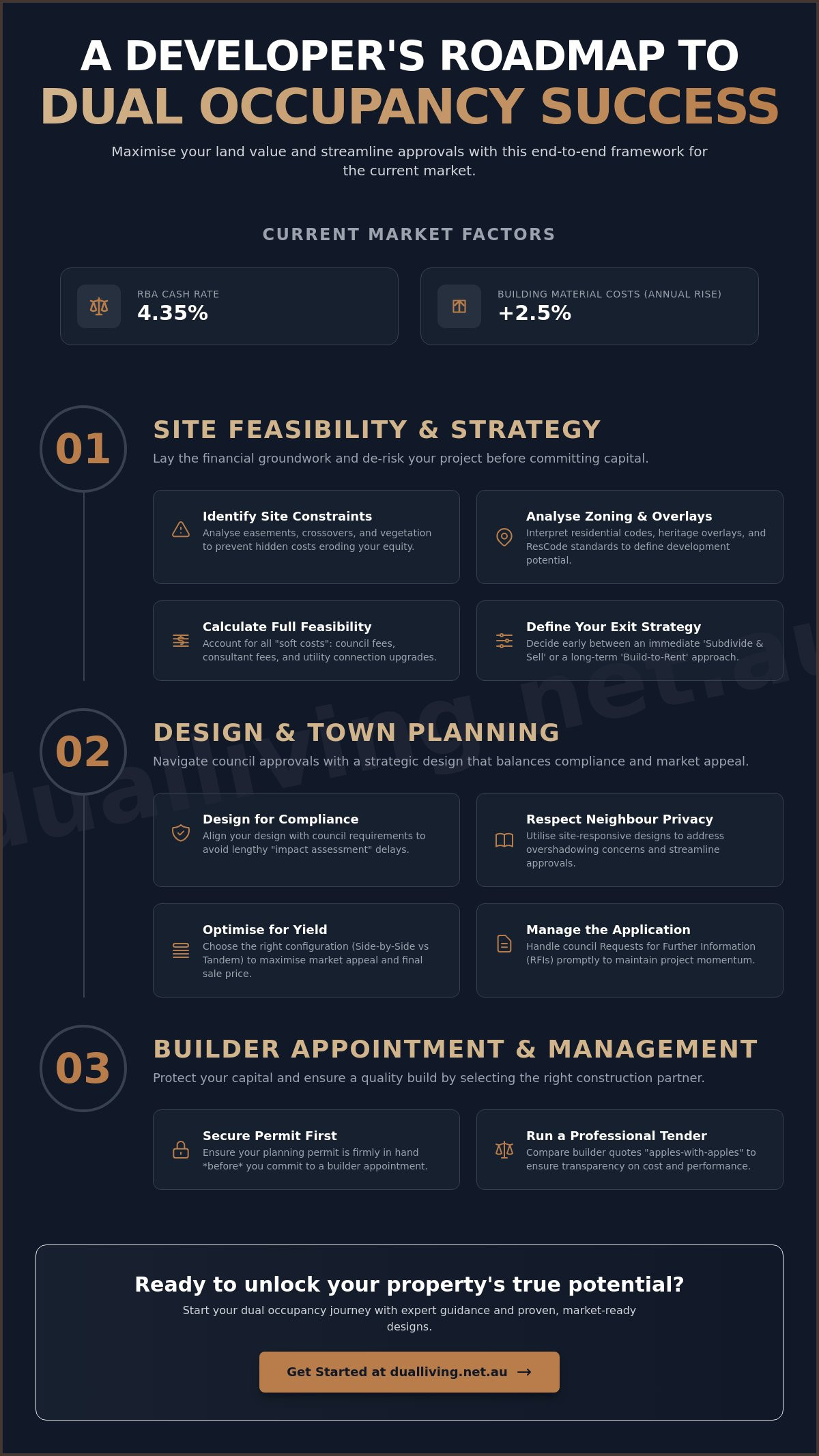
Why settle for a single-dwelling yield when your land could be working twice as hard? Most investors look at a suburban block and see a backyard; savvy developers see a high-yield asset waiting to be unlocked. With the RBA cash rate sitting at 4.35% and building material costs rising 2.5% over the last year, the margin for error in 2026 has never been thinner. You likely already know that the difference between a profitable project and a financial headache is found in the design and approval phase, not just the construction. It is a frustrating reality where hidden subdivision costs and lengthy town planning delays can stall your momentum before the first sod is even turned.
This guide changes the equation. You are about to master how to develop dual occupancy using a strategic roadmap built for the current regulatory landscape. We will show you how to navigate the end-to-end process, from initial feasibility and duplex designs to the final builder appointment. By following this framework, you can maximise your land value and ensure a stress-free approval process. Let’s move past the guesswork and focus on a calculated, business-minded approach to property development.
Key Takeaways
- Identify critical site constraints like easements and crossovers early to prevent hidden costs from eroding your project's equity.
- Master how to develop dual occupancy by aligning your architectural design with strict council requirements to bypass lengthy "impact assessment" delays.
- Protect your investment capital by ensuring a planning permit is firmly in hand before you commit to a builder appointment.
- Utilise a professional tender process to compare builder quotes "apples with apples," ensuring transparency and performance from the start.
- Focus on site-responsive designs that respect neighbour privacy to streamline the town planning application and secure faster approvals.
Step 1: Assessing Site Feasibility and Investment Strategy
In the 2026 property market, dual occupancy is a sophisticated play to maximise equity by building two dwellings on a single title. Before you look at floor plans, you must understand what is a duplex and how it fits your specific block. Success begins with a cold, hard look at site constraints that could derail your budget. Easements, existing crossovers, and significant vegetation are not just details; they are project-killers that dictate your footprint. If you are learning how to develop dual occupancy, your first task is to separate emotional attachment from commercial reality.
The yield versus cost equation is often misunderstood. Bigger houses don't always equal bigger profits. A high-yield dual occupancy investment relies on finding the "sweet spot" where construction costs align with local market demand. You need to determine your exit strategy early. Are you planning a knockdown and rebuild for immediate subdivision and sale, or a build-to-rent strategy to capture long-term capital growth? Your end goal dictates every design choice you make from this point forward.
Zoning and Planning Overlays
Residential zoning codes are the rulebook for your density potential. You must interpret these codes alongside heritage or character overlays that may restrict modern aesthetics or building heights. ResCode, or your state's equivalent planning standard, serves as the non-negotiable baseline for all Australian residential developments. Ignoring these overlays during the feasibility stage leads to expensive redesigns and lost time.
Calculating Your Development Feasibility
Profit isn't what's left over; it's what you plan for. You must account for "soft costs" long before the first brick is laid. These include:
- Council application fees and infrastructure levies.
- Consultant fees for land surveyors, engineers, and arborists.
- Subdivision costs and mandatory utility connection upgrades.
Engaging a property development consultancy is vital here. They identify hidden site risks and provide a realistic roadmap for how to develop dual occupancy without the financial surprises that plague unguided projects.
Step 2: Navigating Design and the Town Planning Application
Mastering how to develop dual occupancy requires more than a vision; it demands a design that councils can't refuse. Architectural excellence must be balanced with strict compliance to avoid the "impact assessment" trap. By creating site-responsive dual occupancy homes that respect neighbour privacy, you significantly reduce the risk of formal objections. In 2026, housing policies in states like NSW have shifted to favour density in R2 zones, but your design must still prove it belongs in the streetscape.
The Request for Further Information (RFI) stage is where many projects lose momentum. A strategic consultant manages your town planning application to ensure responses are clinical and prompt. This keeps the project moving toward the permit stage without unnecessary friction. Speed is an asset. Every month spent in planning is a month of interest costs on your acquisition loan.
Designing for Maximum Yield and Market Appeal
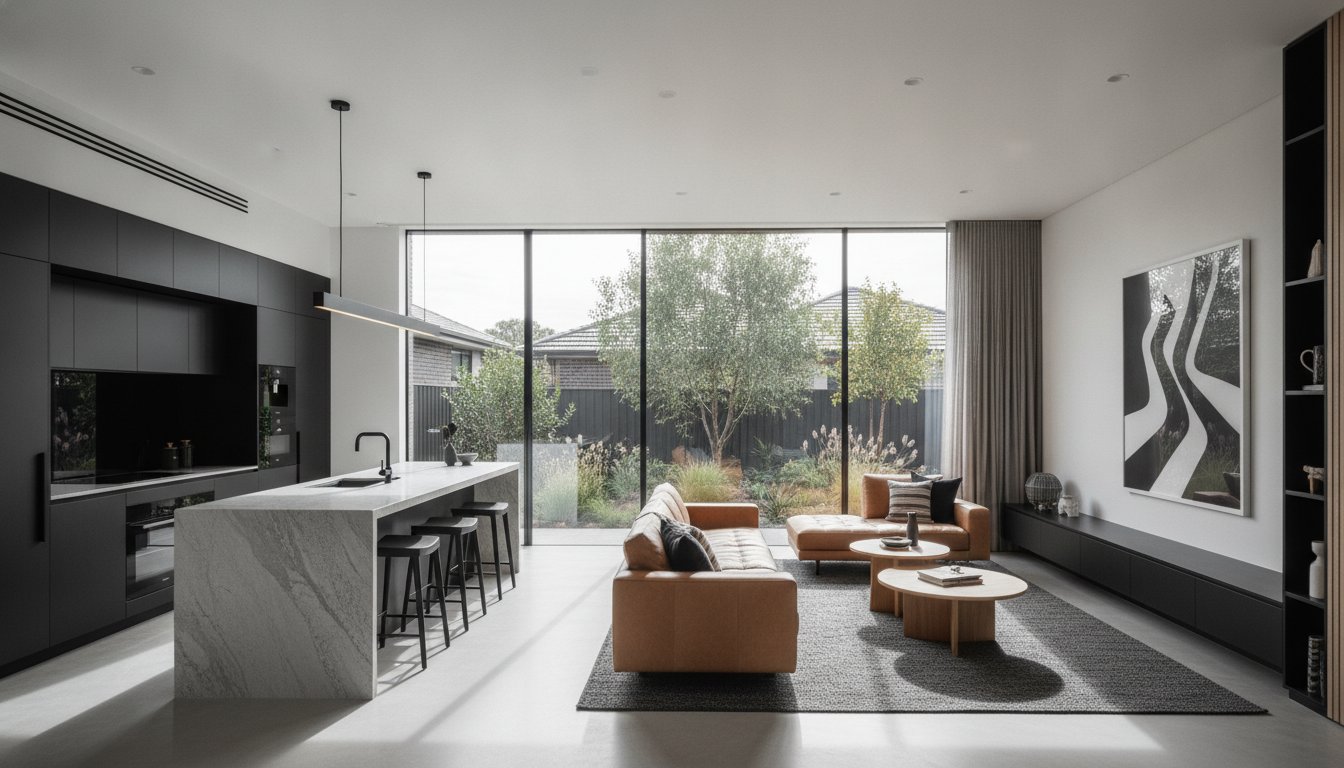
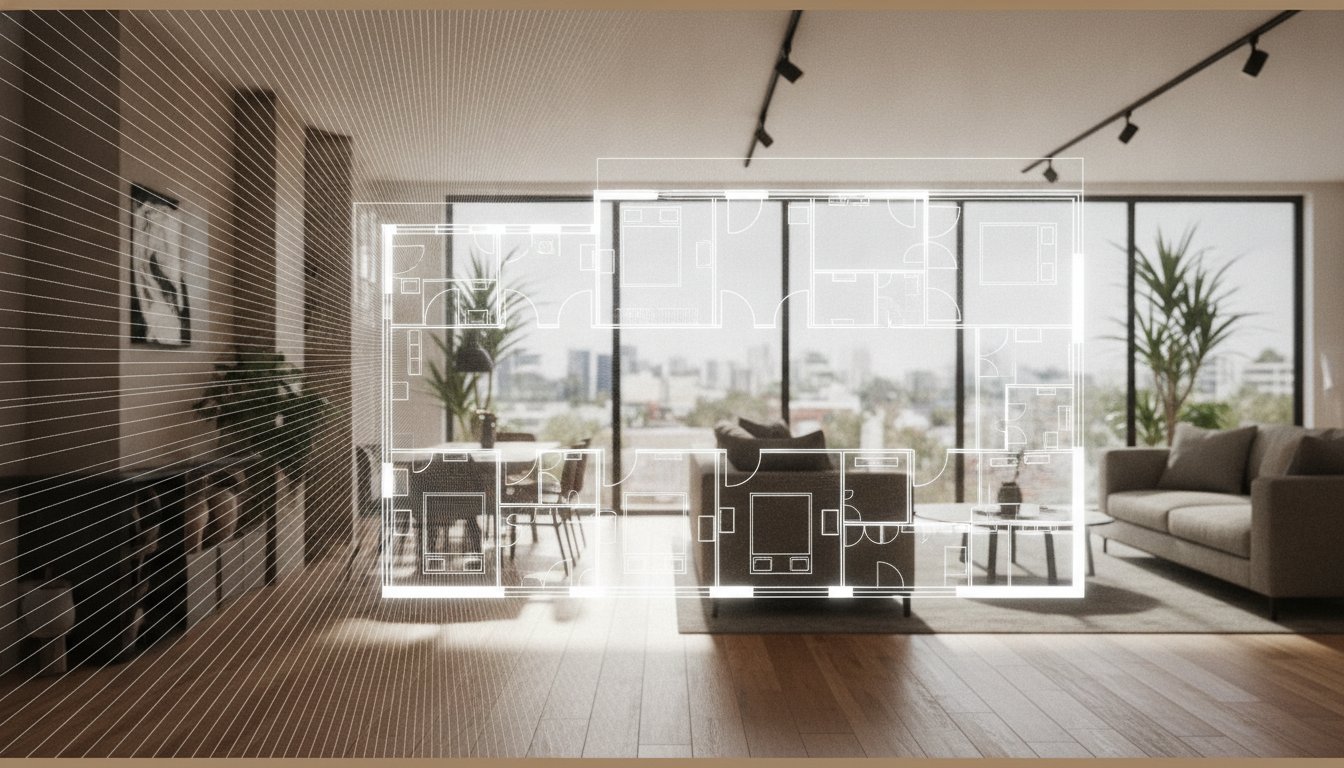
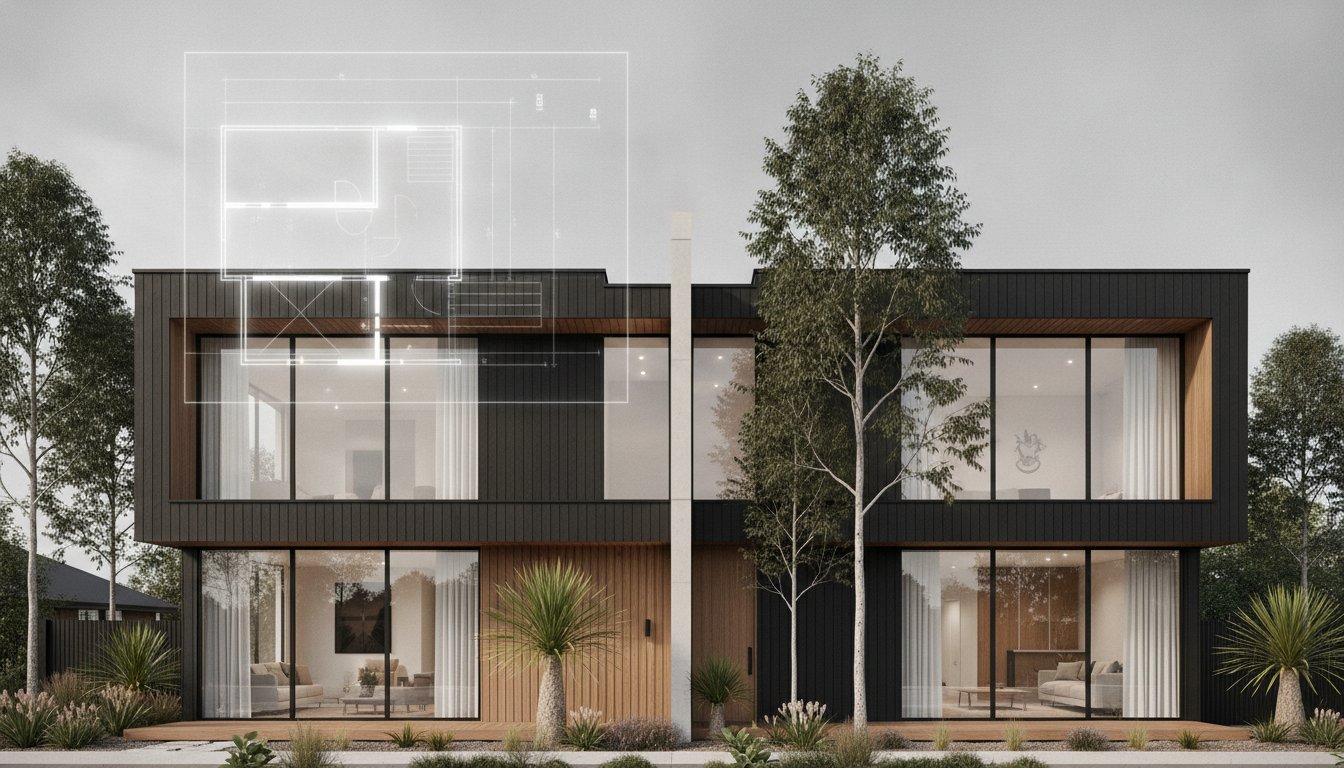
Which configuration suits your block? Side-by-side duplexes often command a premium for street appeal and independent frontage. Tandem (front and back) configurations might be the only viable route for narrower lots or those with specific easement restrictions. You must optimise internal floorplans to ensure both dwellings feel like premium, independent homes. Incorporating "dual living" features such as separate entries and dedicated private open spaces ensures the final product appeals to high-end owner-occupiers. If you're looking for a competitive edge, starting with professional duplex designs ensures your project is marketable from day one.
The Approval Lifecycle: From Submission to Permit
- Pre-application meetings: Identify potential "deal-breakers" with council officers before you spend thousands on detailed drawings.
- Preparing the planning report: Your architectural set must be supported by a professional planning argument that addresses local housing codes.
- Public notification: Handle neighbour objections professionally. Most concerns regarding overshadowing or overlooking can be resolved through minor design tweaks rather than total redesigns.
Step 3: Builder Appointment and Project Management
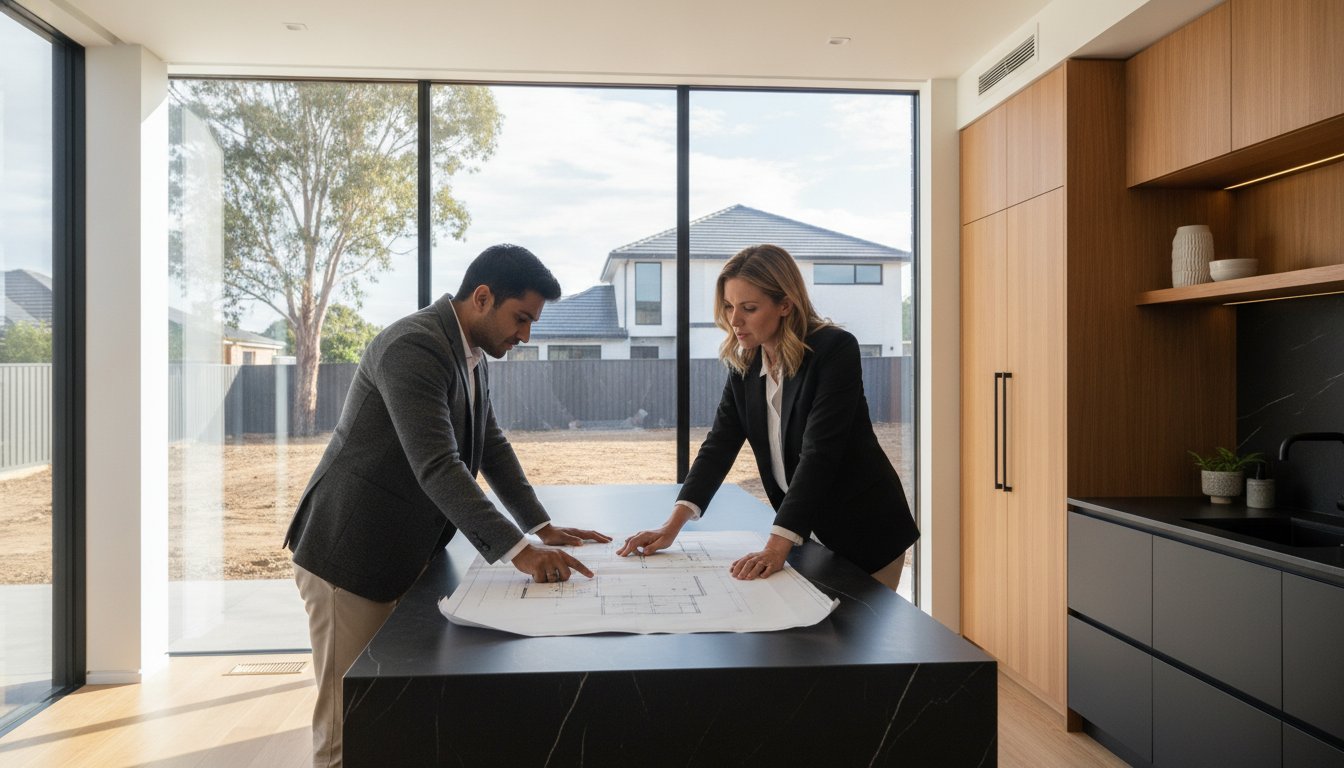
Never sign a building contract before you have your planning permit in hand. This is the golden rule of how to develop dual occupancy. If you appoint a builder too early, you risk being locked into a specific design that council may later reject or modify. By securing your permit first, you maintain complete leverage. You own the approved plans, which allows you to run a competitive tender process and ensures builders are bidding on a fixed, known outcome rather than a moving target.
Transparency is your greatest asset during the transition to construction. An independent builder appointment process allows you to compare "apples with apples" across multiple quotes. You must ensure that demolition, site preparation, and service connections are clearly accounted for. Without this level of detail, you're vulnerable to "hidden" costs that can quickly erode your development margin. Once the builder is selected, your focus shifts to site preparation, ensuring the block is cleared and ready for the first slab pour.
Selecting the Right Dual Occupancy Builder
Does the builder have specific experience with subdivided lots? Working on a tight site with shared services is vastly different from building on a greenfield block. You must interrogate their past projects and review their standard HIA or Master Builders contracts. Pay close attention to "provisional sums" or "prime cost" items. These are often used as placeholders and can lead to significant cost blowouts if they aren't realistic. From July 2026, ensure your Victorian builder is compliant with the new First Resort Home Warranty Scheme, providing essential coverage for any structural or incomplete work.
Subdivision and Final Handover
Construction and subdivision are parallel paths that must meet at the finish line. While the dwellings are being built, you'll need to coordinate with utility providers for separate water, power, and NBN connections. The goal is to obtain a Statement of Compliance from the council, which confirms all planning conditions have been met. This is a prerequisite for final title registration. Only once the titles are separate can you settle on a sale or refinance the properties as individual high-yield assets. Success in how to develop dual occupancy is defined by this final step: turning a single piece of land into two distinct, bankable titles.
Executing Your 2026 Development Strategy
Developing property in the current climate isn't about luck; it's about the calculated execution of a proven roadmap. You've seen that the profit is secured during the feasibility and planning stages, long before the first brick is laid. By prioritising a permit-first approach and conducting a rigorous, independent tender process, you eliminate the guesswork that often leads to budget blowouts. Understanding how to develop dual occupancy with this level of precision is what separates high-yield investors from the rest of the market.
You don't have to navigate these complexities alone. As a specialised dual occupancy consultancy, we provide the expert town planning management and independent builder tender process you need to ensure transparency and performance. We focus on the data and the regulations so you can focus on the growth of your portfolio. Ready to unlock the full potential of your land? Book a Strategic Consultation with Dual Living today. Your next high-yield project starts with a single, strategic decision.
Frequently Asked Questions
What is the minimum land size required to develop a dual occupancy?
Minimum land size requirements vary significantly between local councils and specific residential zones. While some metropolitan councils allow dual occupancy on lots as small as 450 square metres, a more common baseline is between 600 and 800 square metres. You must check your specific local planning scheme for minimum frontage and total area requirements before proceeding with any design work.
How much does it cost to develop a dual occupancy in Australia in 2026?
Construction costs for a duplex in 2026 typically range between $700,000 and $1.5 million, excluding land and soft costs. On a per square metre basis, you should budget between $2,000 and $3,800. These figures reflect recent material cost increases, such as the 2.5% rise in the year leading to March 2026, which was driven by higher prices for electrical equipment and appliances.
Can I build a dual occupancy on a block with an existing house?
Yes, you can develop a dual occupancy on a block with an existing house, provided the site meets minimum size and access requirements. This tandem or front-and-back configuration allows you to retain the original dwelling while building a second unit in the backyard. It is an effective way to generate rental income from the existing asset while you manage the town planning application for the new build.
How long does the town planning process typically take for a duplex?
The town planning process for a dual occupancy typically takes between six and twelve months. This timeline depends heavily on the complexity of your design and the efficiency of your local council. Projects that trigger an impact assessment or face significant neighbour objections during the public notification period can face longer delays. Professional management of your application is essential to keep the project on track.
Do I need to subdivide the land before I start building?
No, you don't need to subdivide the land before you start building. Most developers build both dwellings on the single existing title and complete the subdivision process toward the end of construction. This allows you to obtain a Statement of Compliance and register new titles just as the project reaches practical completion, facilitating a smoother transition to sale or refinance.
What is the difference between dual occupancy and a duplex?
Dual occupancy is a broad planning term for two dwellings on a single allotment of land, whereas a duplex is a specific architectural style where those two dwellings share a common wall. Understanding how to develop dual occupancy involves knowing that while all duplexes are dual occupancies, not all dual occupancies are duplexes. Some configurations involve two completely detached houses on one title.