Is your next project a genuine high-yield opportunity or just an expensive lesson in overcapitalisation? In a market where the RBA cash rate sits at 4.35% and NSW planning laws are shifting, guessing isn't a strategy. Getting your property development feasibility right is the only way to ensure your capital is working as hard as you are. You likely already feel that the difference between a successful duplex and a financial "lemon" often comes down to the numbers you didn't see coming.
We agree that the complexity of local council rules and the uncertainty of subdivision costs can be paralysing. This guide provides a definitive "go/no-go" framework to help you navigate the Planning System Reforms Act 2025 and the updated land tax thresholds with ease. We will break down the essential metrics for risk mitigation and show you how to identify the planning path of least resistance. By the end of this checklist, you'll have the confidence to secure your projected ROI and avoid the traps that catch out unprepared developers.
Key Takeaways
- Identify the "highest and best use" for your land by assessing physical constraints like frontage and orientation to maximise your duplex yield.
- Master a comprehensive property development feasibility by calculating the Total Development Cost (TDC), ensuring you account for more than just construction.
- Protect your margins by factoring in often-overlooked "soft costs" including consultant fees, council contributions, and holding costs.
- Bridge the gap between vision and reality by aligning your architectural designs with realistic builder quotes before committing.
- Establish a clear "go/no-go" framework to mitigate financial risk and ensure your residential project delivers a high-yield outcome.
The Foundations of Property Development Feasibility: Site Assessment
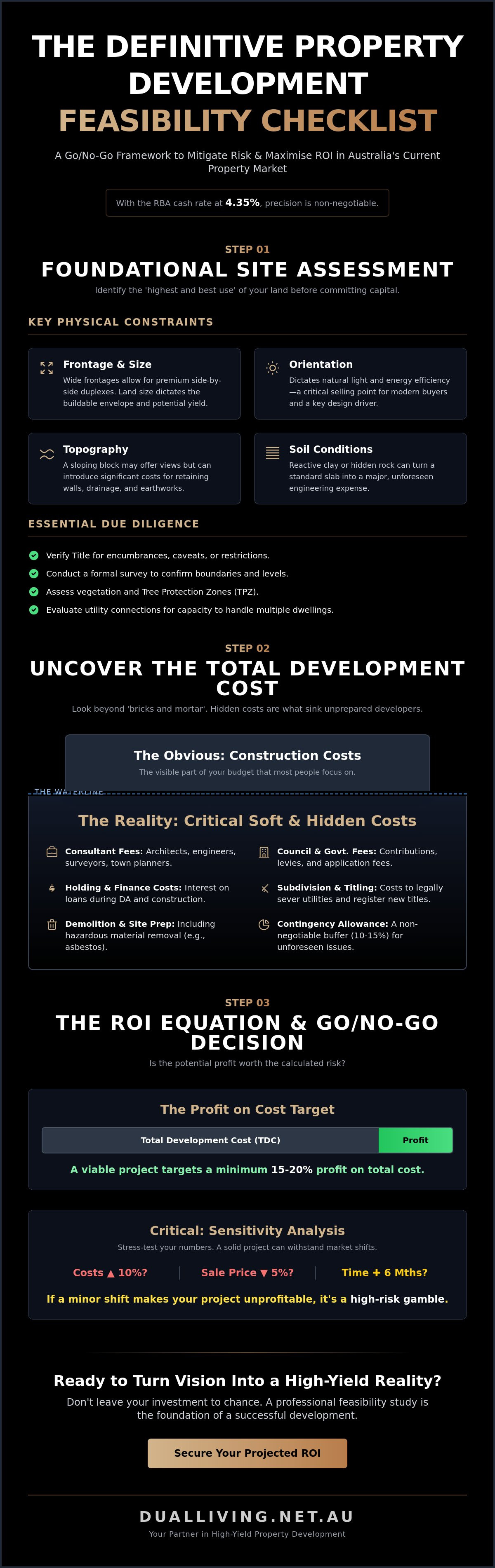
A successful project doesn't start with a hammer; it starts with a brutal assessment of the dirt. Identifying the "highest and best use" of your land is the cornerstone of any property development feasibility. Is the site better suited for a knockdown and rebuild of a single luxury home, or does the frontage allow for a high-yield duplex? Theoretical value is useless if physical constraints like frontage, orientation, and land size don't align with your financial goals.
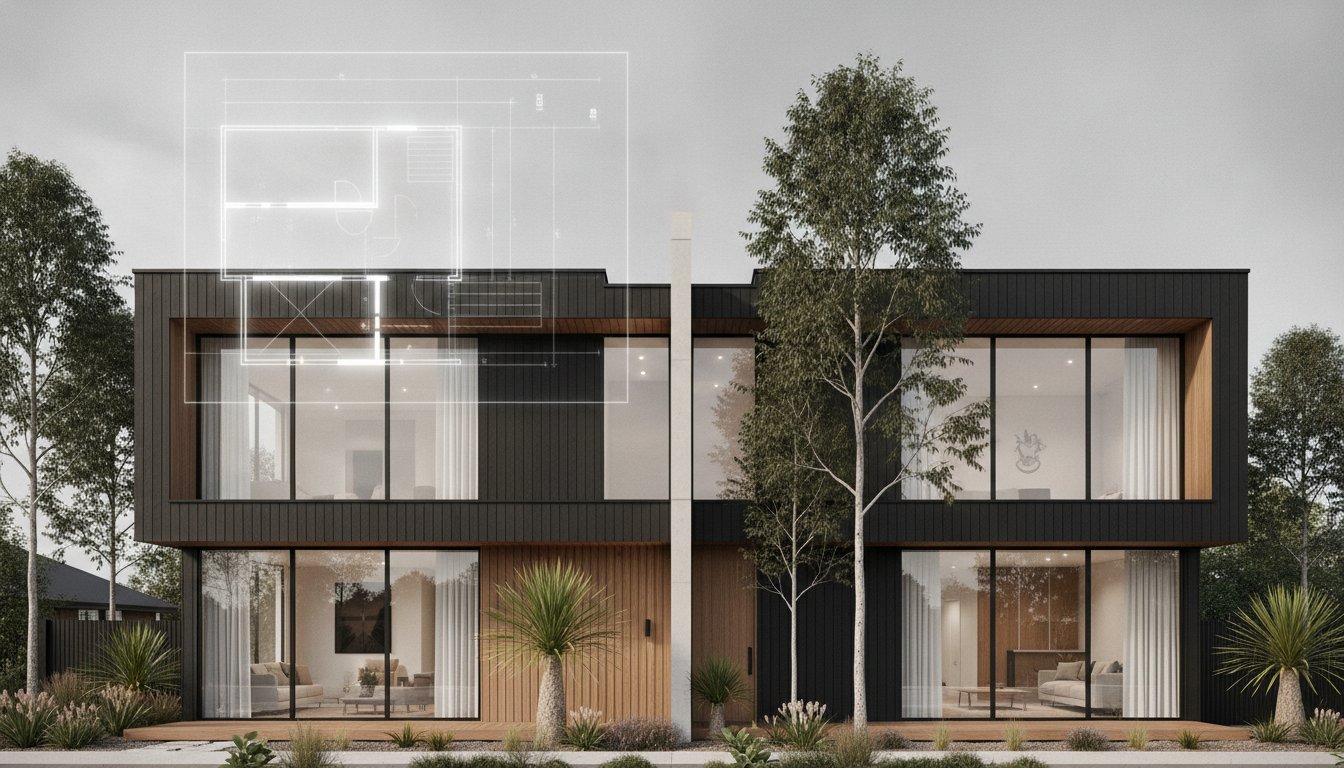
For a duplex, a narrow frontage might force a "tandem" design that buyers find less appealing, while a wide frontage allows for side-by-side units that command premium prices. Similarly, orientation dictates natural light and energy efficiency, which are now non-negotiable for modern buyers. Don't ignore the topography. A sloping block might offer views, but the cost of retaining walls and complex drainage can vaporise your profit margins. Soil conditions are equally critical; reactive clay or hidden rock can turn a standard slab into a major engineering expense. Assessing these factors early in the Real estate development process ensures your budget remains grounded in reality.
Navigating Planning Rules and Zoning Constraints
Your site's potential is strictly governed by local council codes. Understanding dual occupancy regulations is vital to determine if your vision is even legal. Beyond zoning, check for restrictive covenants or easements that might prevent building over certain areas. Neighbourhood character and heritage overlays can also add significant planning friction, requiring more expensive materials or specific architectural styles to gain approval. Does the site have existing infrastructure? Upgrading old sewer lines or electrical pits for a dual occupancy can be a costly surprise if not factored in early.
Site Due Diligence Checklist
Precision at this stage prevents litigation and delays later. Use this checklist to verify the physical and legal reality of your land:
- Verify Title Office records for any encumbrances, caveats, or Section 88B instruments that restrict land use.
- Conduct a formal survey to confirm exact boundaries and levels; never rely on old fence lines or "eyeballing" the slope.
- Assess vegetation and Tree Protection Zones (TPZ) that can drastically reduce your buildable envelope.
- Evaluate utility connections to ensure the site can handle the increased load of multiple dwellings.
The Financial Feasibility Checklist: Mitigating Risk and Maximising ROI
Numbers don't lie, but they can be manipulated to tell a story that ends in financial ruin. A robust property development feasibility looks beyond the surface level "bricks and mortar" costs to uncover the Total Development Cost (TDC). Are you factoring in the 4.35% RBA cash rate when calculating your interest on development finance? If your model doesn't account for the current "higher-for-longer" interest rate environment, your margins are already compromised. Savvy developers use a "Sensitivity Analysis" to stress-test their project. What happens to your bottom line if construction costs spike by 10% or if the market cools during your build? If a minor shift wipes out your profit, the project isn't a deal; it's a gamble.
Success requires professional rigour in Feasibility and Hurdle Rate Selection to determine if a project meets your minimum investment criteria. Soft costs, such as specialist consultants and holding costs during a complex town planning application, often represent the difference between a high-yield outcome and a break-even disaster. It's about precision over optimism.
Hidden Costs That Sink Residential Developments
Many first-time developers overlook the "housing and productivity contribution" now levied on new developments in Greater Sydney. Your budget must also provision for:
- Demolition and asbestos removal, which can escalate quickly on older sites.
- Council open space levies and state infrastructure contributions.
- Subdivision costs, including utility severs and the registration of new titles.
The ROI Equation: Is the Juice Worth the Squeeze?
A viable project generally targets a minimum 15-20% profit on cost. Why settle for a single luxury home build when a duplex planning application could potentially double your density and significantly boost your yield? While the lifecycle is longer, the cash flow implications of dual occupancy often outweigh the simpler path. Before you commit, it's wise to review your duplex design potential to ensure the site can actually support your revenue forecasts.
Strategic Execution: From Feasibility to Builder Appointment
A "paper profit" is a dangerous illusion until it's backed by a binding contract. Too many developers treat their property development feasibility as a static document that ends once the land is purchased. In reality, the most critical phase is transitioning from theoretical numbers to a shovel-ready project. If your architectural design isn't strictly aligned with a realistic construction budget, you've simply designed a project you can't afford to build. Strategic execution requires "stress-testing" every assumption with market-based data from the people actually doing the work.
The Critical Role of Builder Appointment
Waiting until you have a DA to talk to builders is a rookie mistake. Your builder appointment should happen much earlier in the process. Market conditions in 2026 remain volatile. A volume builder might offer a lower headline price but lack the flexibility for a complex dual occupancy on a sloping site. Conversely, a custom builder brings expertise but requires a higher margin. Proper tender management ensures your feasibility inputs match current market reality, not just outdated industry averages. It's about finding a partner, not just a price.
Final Feasibility Sign-Off
Before you pull the trigger, your model needs a final layer of professional rigour. For high-stakes residential projects, obtaining a quantity surveyor (QS) report is non-negotiable. This provides the granular detail lenders require for finance pre-approval. Your final sign-off should include:
- A detailed project timeline with clear milestones and "exit" points.
- Locked-in quotes that account for the 2026 NCC transition periods and NSW variations.
- A confirmed finance structure based on your stress-tested ROI.
Confidence comes from certainty. By the time you appoint a builder, your property development feasibility should be a foolproof roadmap to completion, not a list of unanswered questions.
Turn Site Potential into Scalable Profit
Success in the 2026 property market isn't about luck; it's about the rigour you apply before the first sod is turned. You've seen how a meticulous site assessment and a stress-tested financial model form the backbone of a viable project. Moving from a "paper profit" to a shovel-ready site requires more than just a spreadsheet. It requires the strategic alignment of design, planning, and builder expertise. Getting your property development feasibility right today ensures your capital is protected against market fluctuations tomorrow.
Beyond the physical construction, establishing digital authority is vital for modern developers looking to market their projects effectively. Understanding how online presence is measured through resources like purplecow.digital can provide a significant competitive advantage when reaching potential buyers.
As specialists in dual occupancy and duplex developments, Dual Living provides the end-to-end project management you need to navigate complex Australian planning rules. We bridge the gap between architectural vision and builder appointment, ensuring your project is grounded in reality from day one. Book a strategic feasibility consultation with Dual Living today.
Take the guesswork out of your next residential project. With the right framework in place, you can move forward with the confidence that your project is a high-yield opportunity rather than a financial risk.
Frequently Asked Questions
What is the most important factor in a property development feasibility?
The most critical factor is the accuracy of your Total Development Cost (TDC) and revenue assumptions. Many developers fail because they use "best-case" scenarios rather than realistic, stress-tested data. A high-quality property development feasibility must account for the current 4.35% RBA cash rate and the actual cost of local infrastructure contributions. If your inputs are off by even a small margin, your projected 15-20% profit can quickly disappear.
How much does a professional feasibility study cost for a duplex?
Professional fees for a feasibility study depend entirely on the site's complexity and the required level of technical detail. A basic "high-level" assessment is less intensive than a full bank-ready report that includes a quantity surveyor's input. Instead of focusing on the upfront cost, savvy investors view this as an essential insurance policy. It's far cheaper to pay for a professional "no-go" decision than to discover a million-dollar planning error mid-build.
Can I do my own property development feasibility using Excel?
You can certainly use Excel for a preliminary "back-of-the-envelope" check, but it rarely captures the full picture. Standard spreadsheets often overlook hidden variables like the NSW "housing and productivity contribution" or the specific holding costs associated with the Planning System Reforms Act 2025. While a DIY property development feasibility is a good starting point, it shouldn't be the final word before committing millions in capital.
How long does the feasibility phase typically take for a dual occupancy?
A thorough feasibility phase generally takes between two to four weeks to execute properly. This timeframe allows for the collection of essential site data, including formal surveys, soil tests, and an analysis of existing utility connections. Rushing this stage is a common mistake that leads to expensive "surprises" during the construction phase. Taking the time to stress-test your assumptions ensures the project is actually shovel-ready and financially viable.