A builder's quote is rarely the final price of a finished project. Most landowners treat a preliminary estimate as a fixed budget. In the 2026 market, that's a fast track to a stalled site and depleted equity. If you are looking at duplex construction costs melbourne is currently seeing, you've likely noticed that the gap between a base price and a turnkey finish has never been wider. It's a calculated risk that requires a strategic, no-nonsense approach.
You're likely feeling the pressure of rising material costs and the mandatory 7-star energy rating requirements. It's frustrating to navigate inconsistent quotes while trying to account for the latest Building and Plumbing Commission standards. We'll show you exactly how to calculate the total investment required to develop a high-yield duplex in today's regulatory environment. This guide provides a clear per-square-metre benchmark, a checklist of site variables that drive costs up, and the data you need to confirm project feasibility before you commit your capital.
Key Takeaways
- Understand the discrepancy between base marketing quotes and the genuine per-square-metre benchmarks required for a premium metropolitan finish in 2026.
- Identify the site-specific variables, such as soil classification and slope, that typically drive up duplex construction costs melbourne landowners must account for early.
- Budget accurately for the 2026 regulatory environment by factoring in updated town planning fees and the mandatory 7-star energy rating standards.
- Evaluate why professional consultancy and strategic project management are critical investments that safeguard project feasibility and maximise long-term yield.
Benchmarking Duplex Construction Costs in Australia for 2026
"Starting from" prices on builder websites are marketing tools; they rarely reflect the final invoice for a high-yield project. A Duplex (building) in the Australian context requires a dual-occupancy strategy that accounts for shared infrastructure and independent services. While base costs are rising, building two dwellings on a single title remains a superior financial play. It offers a lower per-unit cost than two separate builds because you're leveraging shared resources and a single mobilisation fee.
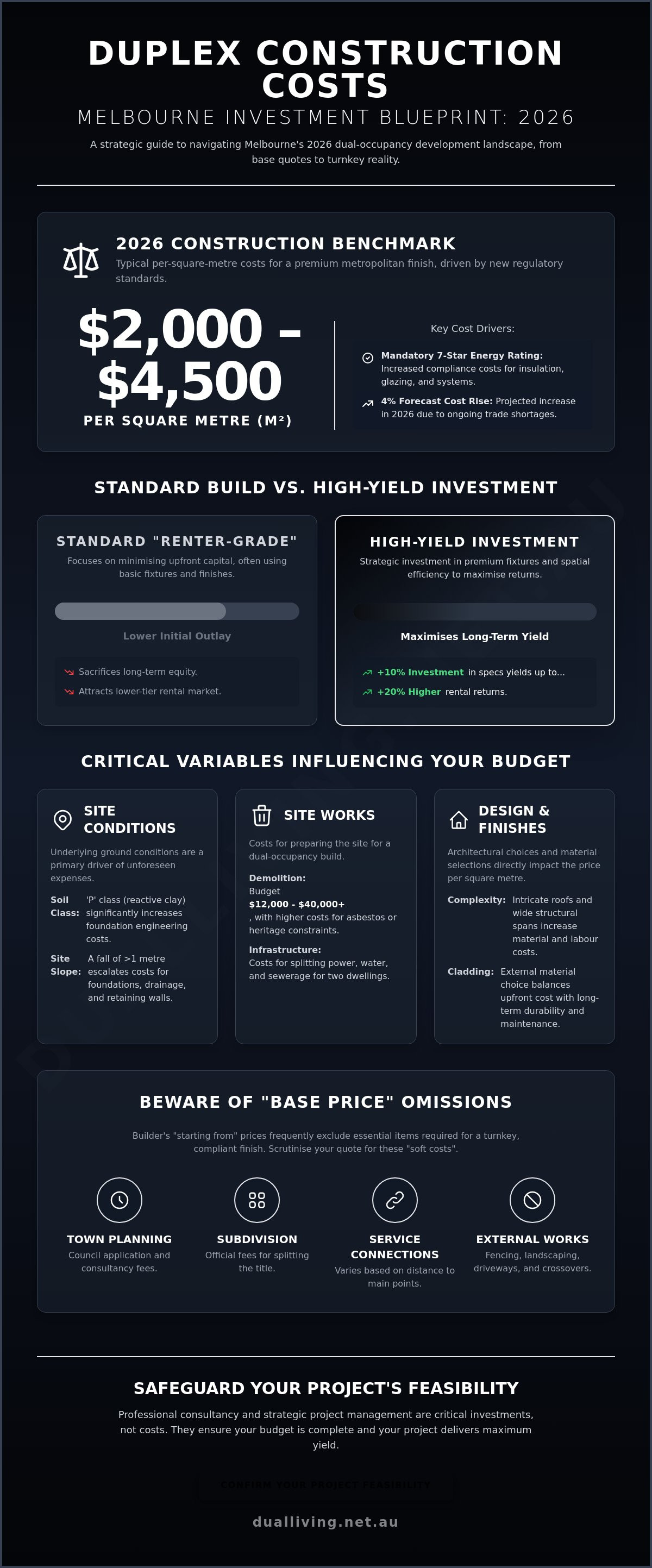
Accurately calculating duplex construction costs melbourne landowners face in 2026 requires a focus on the new regulatory baseline. The Building and Plumbing Commission (BPC) now enforces strict compliance with 7-star energy standards. These mandates have pushed typical costs to between $2,000 and $4,500 per square metre. While construction costs are forecast to rise by 4% this year due to trade shortages, the efficiency of a dual-occupancy build remains a high-performance investment strategy compared to standalone residential projects.
Standard vs. High-Yield Investment Specifications
There is a sharp distinction between renter-grade builds and owner-occupier luxury. A basic build might save capital upfront, but it often sacrifices long-term equity. Strategic duplex designs focus on spatial efficiency and premium fixtures. Evidence suggests that investing an extra 10% in high-quality specifications can yield up to 20% higher rental returns in competitive metropolitan markets. Quality isn't just an aesthetic choice; it's a financial filter that attracts higher-tier tenants.
The m2 Budgeting Framework
Effective budgeting relies on Gross Floor Area (GFA) rather than just the number of bedrooms. You must scrutinise "turnkey" inclusions to avoid post-contract variations that erode your margin. A lean budget is only successful if it is complete from the outset.
- Fencing and Landscaping: These are frequently excluded from base quotes but are essential for a statement of compliance.
- Driveways and Crossings: Crucial for final certification and often subject to specific council requirements.
- Service Connections: Costs vary significantly based on existing infrastructure and the distance to main connection points.
Transparency in the initial quote is the only way to ensure project feasibility. If a quote seems too low, it's usually because the "soft costs" have been conveniently omitted to secure your signature.
Critical Variables That Influence Your Duplex Build Budget
The total duplex construction costs melbourne investors encounter are often dictated by what lies beneath the surface. While a standard floor plan has a predictable price, site-specific variables introduce significant volatility. Soil classification and site slope are the primary drivers of "hidden" expenses; these are frequently buried within Provisional Cost (PC) sums in building contracts. If your block has a "P" class soil rating or a fall of more than a metre, expect your foundation and drainage costs to escalate quickly. Engineering requirements for reactive clay or steep terrain aren't optional extras. They are structural necessities that must be costed upfront.
Site Conditions and Civil Works
A significant site scrape or the requirement for structural retaining walls can add tens of thousands to a budget. Before committing to a purchase, conducting thorough feasibility checks is essential to identify these civil requirements early. Beyond the dirt, demolition is a major factor. For a knockdown rebuild in Melbourne, budgeting between $12,000 and $40,000 for demolition is standard, though asbestos removal or heritage constraints can push this higher. Infrastructure upgrades are equally critical. You aren't just connecting one house; you're splitting power, water, and sewerage for two independent dwellings. Review the official subdivision fees to understand the statutory costs associated with this process in the 2026-2027 financial year.
Design and Finish Selections
Architectural complexity directly impacts the final tender price. Intricate roof lines and wide structural spans require more steel and labour, increasing the price per square metre. Your choice of external cladding also matters. You need to balance immediate aesthetic appeal with long-term, maintenance-free durability to protect your yield. Smart duplex floor plans optimise the volume of materials required by aligning wet areas and minimising wasted hallway space. If you are looking for a way to mitigate these risks, engaging with a specialist in dual occupancy can provide the clarity needed to secure a fixed-price contract before the first sod is turned.
The "Soft Costs" of Duplex Development: Planning and Subdivision
Focusing solely on the build contract is the most common mistake in property development. While the physical structure is the largest expense, "soft costs" for consultancy, permits, and subdivision typically add $50,000 to $100,000 to the total project budget. Ignoring these figures makes your feasibility study worthless. For a realistic view of duplex construction costs melbourne investors must look beyond the slab and factor in the professional expertise required to reach a statement of compliance. You can reference the latest construction cost data to see how these regulatory and professional requirements now form a significant portion of the modern build baseline.
Town Planning and Regulatory Approvals
In the 2026 regulatory environment, a standard two-lot residential subdivision in Melbourne involves professional fees and government charges between $15,000 and $30,000. This excludes construction. You'll need specialist reports from arborists, traffic engineers, and drainage consultants to satisfy council requirements. A strategic town planning application is your best insurance policy. It minimises the risk of expensive VCAT appeals or protracted court battles that can stall your project for months. Holding costs like interest, land tax, and council rates continue to accumulate during the 12 to 18 month development lifecycle; every delay is a direct hit to your ROI.
The Value of Expert Builder Appointment
Why go directly to a single builder? A competitive tender process through a specialised builder appointment consultant can save 5% to 10% on total build costs. This process exposes the "builder margin" and reveals the actual cost of materials and labour. When developing dual occupancy homes, the goal is to secure separate titles as efficiently as possible. Legal fees and surveying are non-negotiable steps on the path to those titles. By managing these soft costs with the same rigour as your construction budget, you transform a risky build into a calculated financial execution.
Securing Your Development Margin in 2026
Success in property development isn't about finding the cheapest builder. It's about mastering the total project feasibility. You now understand that the true duplex construction costs melbourne landowners face include a complex mix of 7-star energy compliance, site-specific civil works, and essential soft costs. A project that looks profitable on a basic builder's quote can quickly erode if you haven't accounted for the professional fees and subdivision requirements discussed in this guide.
Dual Living provides the independent consultancy required to navigate this landscape. We are specialists in high-yield dual occupancy and coliving projects, offering end-to-end management from initial design through to the final builder appointment. Our focus is strictly on your ROI. We ensure every dollar spent on construction translates into maximum equity and long-term stability.
Book a Strategic Feasibility Call with Dual Living to validate your project's potential. Don't leave your margins to chance. With a strategic partner by your side, your duplex development can become a high-performance asset that thrives in the current Australian market.
Frequently Asked Questions
How much does it cost to build a duplex in Australia in 2026?
Building a duplex in 2026 typically costs between $700,000 and $1.4 million, depending on the level of finish and site complexity. On a per-square-metre basis, you should budget between $2,000 and $4,500 to account for mandatory 7-star energy requirements. When calculating the total duplex construction costs melbourne landowners encounter, remember to exclude the land purchase price and initial demolition from this build-only figure.
Is it cheaper to build a duplex or two separate houses?
Building a duplex is significantly more cost-effective per unit than constructing two detached houses on separate sites. You save capital through shared structural walls and common service trenches. Mobilising a single builder for one site reduces overheads and site management fees. This efficiency makes dual occupancy a superior strategy for investors looking to maximise the yield of a single land parcel without doubling their preliminary expenses.
What are the hidden costs in a duplex build contract?
Hidden costs often lurk within "Provisional Cost" (PC) sums for site works and utility upgrades. You'll frequently encounter unexpected charges for reactive soil conditions or the requirement for a new substation if the local grid can't support two dwellings. Statutory fees for subdivision and specialist reports from arborists or traffic engineers are rarely included in a standard builder's quote. It's these "soft costs" that often catch unprepared developers off guard.
How long does the duplex construction process take from design to handover?
A typical duplex project takes between 18 and 24 months from the initial design phase to final handover. You should allow 8 to 12 months for the design and town planning application process, followed by another 10 to 14 months for the physical construction. Timelines vary based on council backlog and the complexity of your specific site conditions. Planning for a two-year lifecycle helps you accurately calculate your holding costs and interest requirements.